Exhibitions Plus Digital: How Bigbeat Inc. Generates B2B Leads Across ASEAN




For a Japanese B2B company entering ASEAN, an exhibition booth gets you in the room, but digital is what turns that visibility into a steady stream of leads. This is a case study of Bigbeat Inc., a Tokyo-based B2B marketing and advertising agency established in 1995. It provides end-to-end marketing support for both foreign firms entering Japan and Japanese enterprises expanding into ASEAN, particularly in Vietnam and Thailand, where the company owns local subsidiaries. To build demand across Southeast Asia, it pairs trade shows with paid media, webinars, and whitepapers. It runs that digital layer with a local partner on the ground in Vietnam: Feedforce Vietnam.
Key takeaways
- ASEAN is one of the markets Japanese companies most want to expand into. In JETRO's FY2025 survey, 56.9% of Japanese firms in Vietnam planned to grow their business there, the highest expansion appetite in ASEAN. The opportunity is real, but presence alone does not convert.
- Exhibitions create awareness; digital lead generation captures and nurtures the demand. B2B buyers spend most of their decision away from your booth, so a booth without a digital follow-up leaks pipeline.
- Running ads in ASEAN is not the same as running them in Japan. Local user interests, ad creative, the platform mix, and fast-moving trends all differ, which is why Bigbeat Inc. chose a local operating partner.
- The channels that work here are a mix: paid media for reach and lead capture, plus webinars and whitepapers to qualify and nurture buyers.
- Trust compounds. Since 2023, Bigbeat Inc.'s engagement has grown from its own campaigns to co-supporting selected client accounts, as results and response quality were proven.
The opportunity: why Japanese B2B firms are looking at ASEAN
Japanese companies have a growing need to open overseas markets, and ASEAN sits near the top of the list. In JETRO's FY2025 survey of Japanese firms operating abroad, 56.9% of Japanese companies in Vietnam said they planned to expand their business over the next one to two years, the highest expansion appetite of any ASEAN market and well above the regional average of 46.8%.
The pull is structural. Vietnam drew about US$38.4 billion in registered foreign investment in 2025, with manufacturing taking 56.5% of the new capital, so the base of manufacturers and enterprises that Japanese firms sell to keeps growing. ASEAN as a whole is already about a US$3.8 trillion economy and widely expected to keep climbing the global rankings.
Bigbeat Inc. sees the same picture from the marketing side. As they describe it, the importance of B2B marketing that combines exhibitions with digital is rising year after year across ASEAN, with manufacturing leading the expansion. The opportunity is large, but simply showing up at a trade show is no longer enough to produce results. That gap between presence and pipeline is the whole reason this case exists.
Why exhibitions need a digital layer
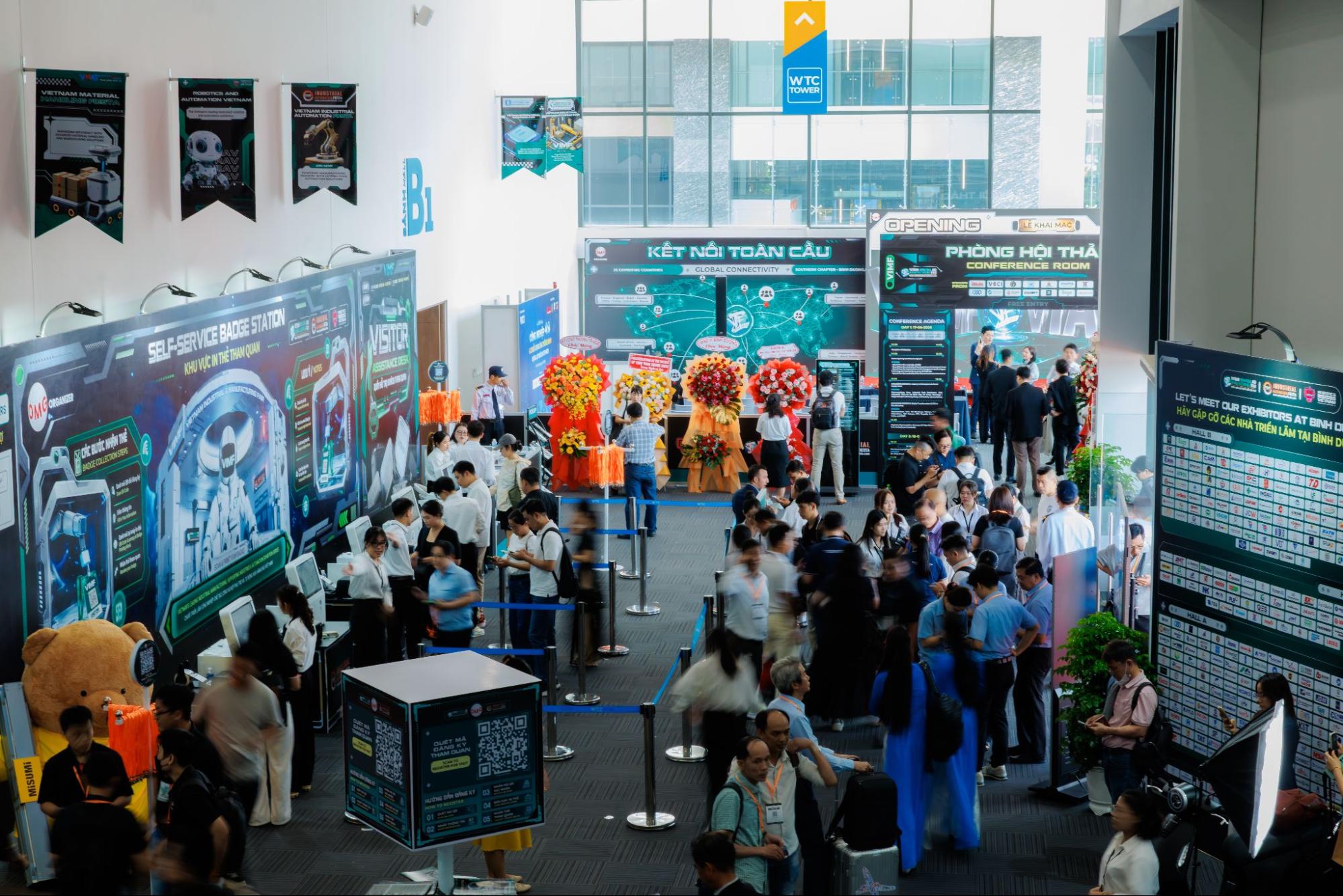
Trade shows still matter in ASEAN, and they are growing. The global exhibition industry hit record revenue in 2024, up about 17% year on year, and Vietnam's industrial expos are part of that story: METALEX Vietnam drew 188 exhibitors from 14 countries and targeted more than 15,000 trade buyers in 2024, while the Vietnam Manufacturing Expo gathered over 200 machinery brands from 20 countries. For many Japanese firms, an exhibition is still the anchor of a market-entry plan.
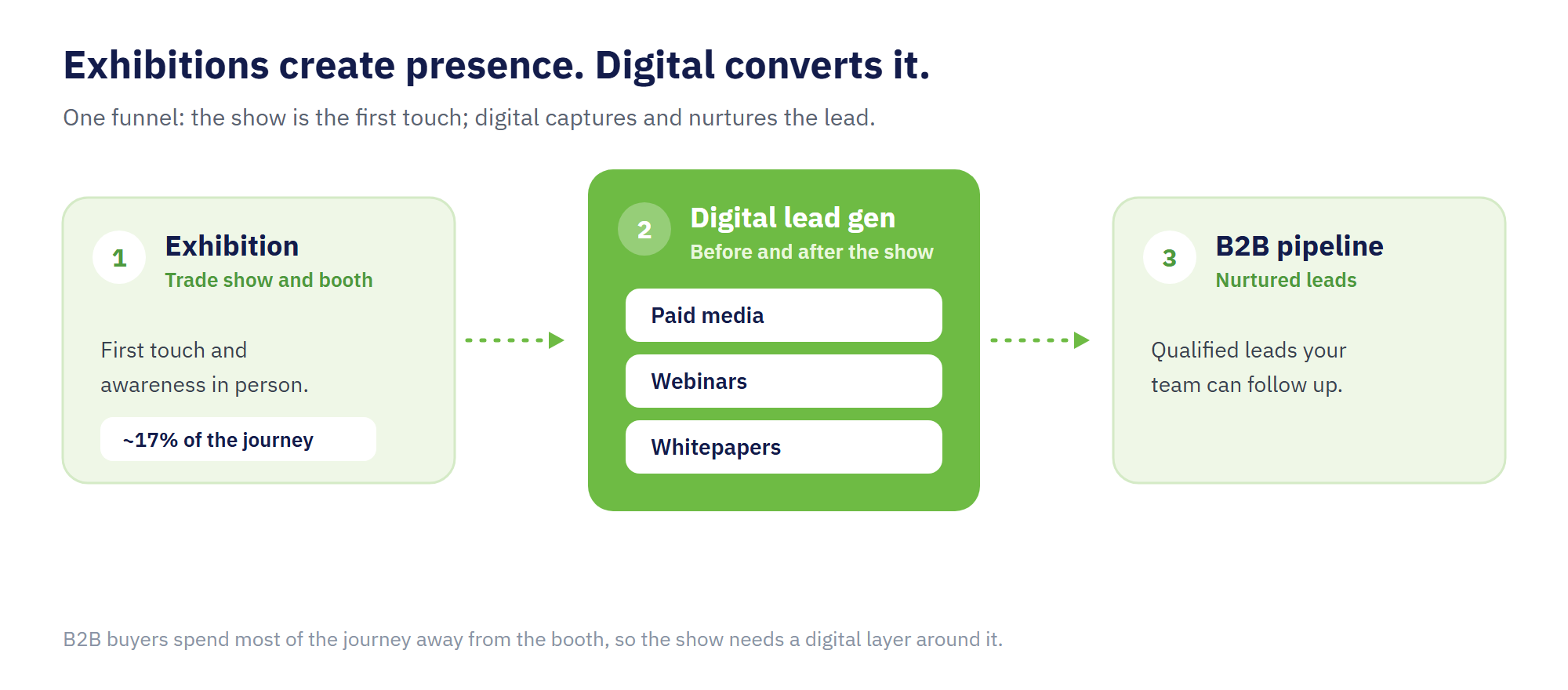
The problem is what happens before and after the show. Gartner finds that B2B buyers spend only about 17% of the entire purchase journey meeting with potential suppliers, and roughly three in four now prefer a self-service, rep-free buying experience. Most of the decision happens away from your booth and your sales team, largely online. A visitor scans your stand, takes a brochure, goes home, and researches you digitally, if they remember you at all. Without a digital layer around the event, that interest evaporates.
This is where digital lead generation does the real work. Paid media builds awareness before the show and re-engages visitors after it. Webinars give a prospect a reason to raise their hand and share contact details. Whitepapers help qualify who is genuinely in-market. It is a proven pairing: Content Marketing Institute's 2025 benchmarks rank in-person events (52%) and webinars (51%) as the two most effective B2B content distribution channels. Used together, exhibitions and digital stop being two separate activities and become one funnel: the show creates the first touch, and digital converts and nurtures it into a lead you can follow up. We explored this approach in our webinar on generating overseas B2B meetings through exhibitions and digital; for Bigbeat Inc., that combination, not the booth on its own, is what makes ASEAN market development work.
What makes ASEAN B2B marketing hard to run from Japan
Deciding to invest in digital is the easy part. Running it well in a foreign market is where Japanese teams hit friction, and Bigbeat Inc. is candid about why.
It is not only the mechanics of ad operations. Local user interests, the way ad creative should be expressed, and the characteristics of each platform all differ from Japan, and staying on top of local conversations and trends over time is genuinely hard from a Tokyo desk. Vietnam is a large, mobile-first market, with 85.6 million internet users, about 84% of the population, at the start of 2026, but the platform mix is not Japan's. Zalo, the homegrown messenger, reaches roughly 85% of Vietnamese and is used by more than 155,000 businesses, and it has no Japanese equivalent. LinkedIn, the main channel for reaching Vietnamese professionals, passed 10 million members and grew 16.3% in a year, the fastest of any major platform, while Facebook and search still carry the bulk of reach.
Language is the other trap. Across markets, 76% of consumers prefer content in their own language and 40% will not buy in another language at all, and the same principle holds in B2B: a Vietnamese campaign translated word for word from a Japanese asset underperforms, and audiences feel it.
That is the case for a local partner. In Bigbeat Inc.'s words, they wanted to work with a partner who understands the local market while still communicating smoothly with a Japanese head office. The hard requirement was not "an agency that can run ads," but a partner who could bridge the local market and the Japanese head office at the same time. That combination, local fluency plus Japanese-side communication, is rarer than it sounds. It is also the argument we make in why digital marketing in Vietnam takes more than platform skills, and this case is that argument in practice.
Inside the partnership: what Feedforce Vietnam runs for Bigbeat Inc.
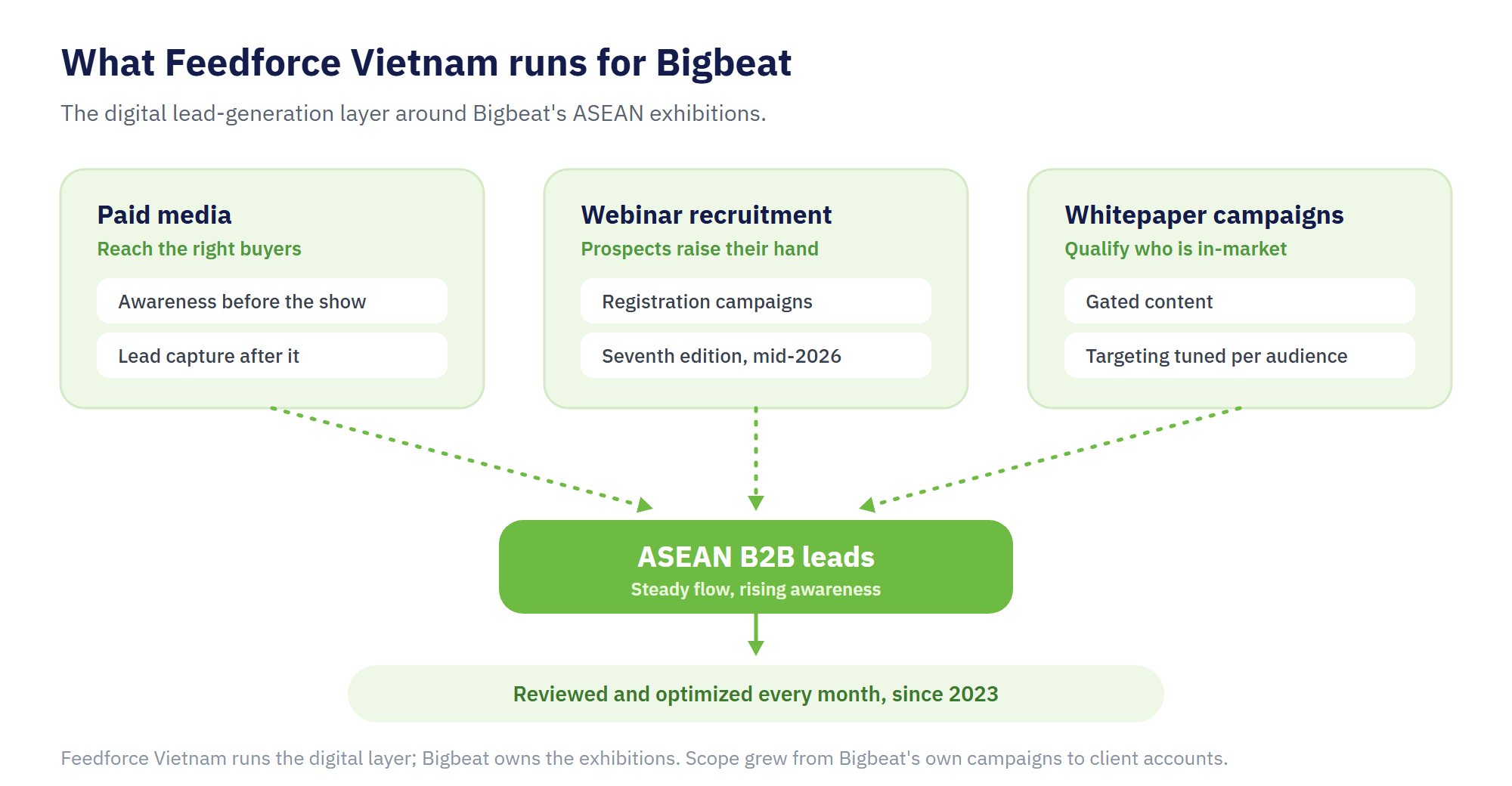
Since 2023, Feedforce Vietnam has run the digital lead-generation layer for Bigbeat Inc.'s ASEAN activity. In practice that means paid media aimed at lead capture, plus support for the demand-generation content that B2B buyers actually respond to: webinar recruitment and whitepaper campaigns.
On what has worked, Bigbeat Inc. points first to the paid media:
“On Meta, they keep refining the delivery based on the results, and it has turned into a steady flow of leads. For webinar recruitment and whitepaper campaigns too, they keep tuning the targeting and proposing improvements.”
The decisive factor, though, was not just competence with the tools. It was the operating relationship:
“Beyond knowing how to run the ads, they proactively propose improvements based on the results, and their fast response gives us confidence. They are a partner we can trust and rely on.”
Two things separate a lead-gen partner that scales from one that just spends: they optimize against results rather than set-and-forget, and they respond fast enough to keep a Japanese head office confident. Those are unglamorous, but in B2B they are what compounds.
How the engagement grew
Trust in a B2B relationship is earned in one direction: results first, scope second. The engagement started narrow, with paid media for Bigbeat Inc.'s own campaigns. As the numbers and the quality of delivery held up, the remit widened. Bigbeat Inc. describes the shift plainly:
“We started with running ads for our own campaigns. As the results and the quality of the work built up trust, we came to feel we could confidently work together on our clients' projects too.”
That progression, from a company's own account to co-supporting its clients, is the clearest signal a partnership is working; it only happens when the earlier work removed doubt rather than added risk.
The results so far
The consistent win is lead flow. Across exhibition and webinar recruitment, the program has produced a continuous stream of leads and, with it, rising awareness in the ASEAN market. Three years in, the engagement spans paid media and a joint webinar series that reached its seventh edition in mid-2026, with reporting and optimization run on a monthly cadence rather than as one-off bursts.
That cadence is also where the learning lives:
“Using the advertising data to propose improvements has raised the precision of the whole program, and we have built up know-how we could not have gained on our own.”
Asked to rate Feedforce Vietnam as an operating partner, Bigbeat Inc.'s answer is short:
“A partner we trust, who combines a real understanding of the local market with the ability to execute.”
The result to notice is not a single headline number; it is a program that gets more precise every cycle, because the data from each campaign feeds the next one. That compounding is the point of running digital around exhibitions, rather than treating the show as a one-off.
What foreign B2B firms can take from this
Two lessons carry over to any Japanese or foreign company weighing an ASEAN entry.
First, treat exhibitions and digital as one system, not two line items. The booth earns attention; paid media, webinars, and whitepapers convert and nurture it. Skip the digital layer and you pay for presence without pipeline.
Second, the channel mix should keep broadening, with a partner who understands the ground. Bigbeat Inc.'s own ambition for the next phase is telling: they want proposals that go beyond digital advertising into marketing channels unique to the local market. For most firms that also means pairing paid media with organic search and content rather than leaning on one lever, which we cover in why combining organic search with paid ads is the smartest move for foreign brands in Vietnam.
If you want one concrete place to start: before your next exhibition, put retargeting on your booth visitors and stand up a single gated whitepaper, so you capture the roughly 83% of the buying journey that happens away from your sales team. The firms that win in ASEAN are the ones that keep improving with a local partner, not the ones that run a translated Japanese campaign and hope.
Bigbeat Inc.'s closing message to firms heading into the region is worth quoting in full:
“The ASEAN market offers big growth, but the market environment and business customs differ greatly from Japan. Working with a trusted partner who understands the local market, and improving the work continuously, is the shortest path to success.”
Frequently asked questions
How do Japanese companies generate B2B leads in ASEAN?
The approach that works is a combination: exhibitions and trade shows for presence, plus digital lead generation (paid media, webinars, and whitepapers) to capture and nurture the demand. Exhibitions alone rarely convert without a digital layer around them.
Are trade shows still worth it for entering Southeast Asia?
Yes, but as one part of a system. A booth creates awareness and first contact; most B2B buyers then research online before they engage sales. Pairing the show with paid media and content follow-up is what turns visitors into leads.
Why use a local partner to run digital ads in Vietnam or ASEAN?
Local user interests, ad creative norms, the platform mix, and market trends differ from Japan, and they change quickly. A local operating partner who can also communicate smoothly with the Japanese head office bridges both sides, which is hard to do remotely.
Which digital channels work for B2B lead generation in Vietnam?
A mix: paid media for reach and lead capture, webinars to get prospects to raise their hand, and whitepapers to qualify who is genuinely in-market. LinkedIn matters for reaching professionals, and Zalo is a Vietnam-specific channel with no Japanese equivalent. The right blend depends on the product and the buyer.
How long before paid media produces B2B leads?
There is no fixed number, but the gains come from continuous optimization. Programs that refine targeting and creative against results each cycle get more precise and more cost-effective over time, which is why an engaged, responsive operating partner matters.
Where Feedforce Vietnam fits
Feedforce Vietnam builds and runs the digital layer of an ASEAN market entry, with a team that bridges the local market and the foreign head office. That covers paid media and lead capture, webinar and content programs, and the continuous optimization that turns a booth into a pipeline. If you are planning a Southeast Asia entry and want the digital side to actually produce pipeline, our Paid Media Service and Marketing Consultant teams can help you plan it.


