Vietnam is one of Southeast Asia’s most dynamic digital markets. E-commerce is growing, social commerce is strong, and platforms such as TikTok Shop have quickly changed how people discover and buy products.
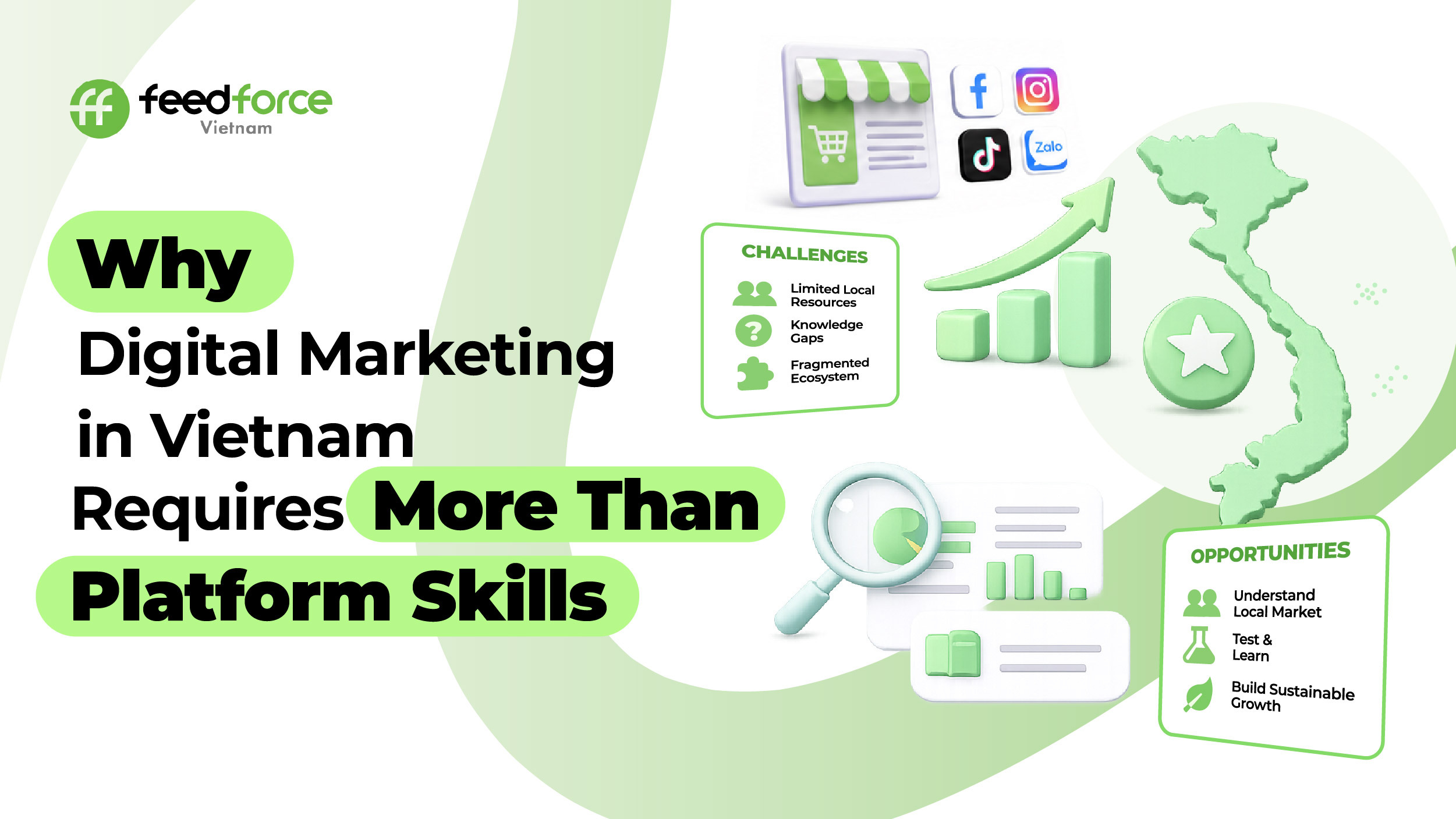
At the same time, digital marketing in Vietnam still has some structural challenges.
For brands entering the market, this is important to understand. Success in Vietnam is not only about knowing how to operate Meta Ads, Google Ads, TikTok Ads, Shopee Ads, or other platforms. It also requires understanding how the market itself is still developing.
Vietnam often receives new ad products later
Many global advertising products are first launched in larger or more mature markets, then become available in Vietnam later.
For example, Google Shopping was introduced globally in the early 2010s, but Shopping Ads became available in Vietnam several years later. Google Performance Max and Meta Advantage+ Shopping Campaigns also followed global rollout patterns before becoming widely used in markets like Vietnam.
TikTok Shop is a special case. It launched in Vietnam in 2022 and grew very quickly. In some areas, Vietnam is not simply “behind” other markets. It is developing in its own way, especially in social commerce.
This means marketers in Vietnam need to learn from global examples, but they also need to test carefully whether those examples really apply locally.
Local learning resources are still limited
Compared with English, and even with Japanese, there are still fewer deep and structured digital marketing resources available in Vietnamese.
There is a lot of practical content online, but advanced topics such as performance marketing strategy, product feed optimization, attribution, creative testing, CRM, and B2B lead generation are not always well documented in the local language.
Because of this, many marketers learn through trial and error. This can build strong practical skills, but it also makes it harder for the market to develop shared frameworks and benchmarks.
There are fewer senior digital marketing veterans
Vietnam’s digital advertising market developed later than markets such as the US, Japan, or Singapore.
As a result, Vietnam has fewer senior marketers in their 40s and above with 15 to 20 years of digital marketing experience. In more mature markets, younger marketers can often learn from managers who have already gone through multiple platform shifts.
In Vietnam, many teams are still building that experience in real time.
This is a challenge, but also an opportunity. Good marketers in Vietnam tend to be flexible, practical, and fast learners because the market itself is changing quickly.
Case studies are still limited
Vietnam has many creative campaigns and strong brand-building examples. However, there are still fewer public case studies about direct response optimization, e-commerce profitability, full-funnel measurement, and performance marketing.
Many brands are still at an early stage of digital maturity. Some are focused on awareness and content. Others run ads, but may not yet have clean tracking, strong product pages, structured product feeds, or clear profit-based KPIs.
That is why many marketing questions in Vietnam are not only platform questions. They are business questions. Of course, this is also true in more mature markets. But in Vietnam, where benchmarks and shared case studies are still limited, these business questions become even more important.
For example:
Which channel should be prioritized: marketplace, TikTok Shop, or the brand website?
Is the product ready for performance marketing?
Is the sales process ready to handle leads?
Are we optimizing for revenue, profit, or only platform-reported conversions?
Marketers need to step closer to the business
In Vietnam, digital marketers cannot rely only on platform operation skills.
They need to understand the product, pricing, margins, distribution, customer behavior, and sales process. Sometimes the real problem is not the ad campaign. It may be the offer, product page, logistics, trust, reviews, or internal follow-up speed.
This is where digital marketing becomes more interesting.
A good marketer is not only someone who manages campaigns. A good marketer helps identify where the business can grow and how marketing can support that growth.
The right mindset
Vietnam’s digital marketing environment still has structural disadvantages compared with more mature markets. There are fewer local benchmarks, fewer public case studies, and fewer senior practitioners with long-term digital experience.
But this also creates opportunity.
If everything were already standardized, it would be harder to create an advantage. In Vietnam, value comes from structuring messy information, learning from other markets, testing quickly, and connecting marketing with business strategy.
At Feedforce Vietnam, we believe this is where marketing teams and agencies can create real value.
The real skill is not only knowing how to operate the latest ad product.
It is understanding what kind of business can win in Vietnam, and how marketing can help make that happen.
Feedforce Vietnam shares practical generative AI use cases for non-engineers, from multilingual ad analysis and proposal review to workflow automation in Google Workspace. The article shows how AI, paired with organizational design, can reduce friction and support smarter agency operations.
This article gives SMEs in Vietnam a clear digital strategy for thriving in a saturated market. It covers campaign structuring, brand storytelling, optimizing KPIs, strategic ads, and using Shopify. Focusing on data-driven tactics, it also highlights common pitfalls and how to avoid them.