As a digital agency based in Ho Chi Minh City, Vietnam, we have compiled a set of practical generative AI use cases, primarily centered around Google Workspace, designed specifically for non-engineers.
We are eager to exchange ideas with other companies on how AI is being utilized in digital advertising. Additionally, our experience as a trilingual team (Japanese, English, Vietnamese) focusing on breaking down language barriers may serve as a useful reference.
To create real value, these efficiency gains must be paired with solid organizational design. In the near future, autonomous agents will likely replace many manual tasks and eliminate communication friction**.** However, we believe that mastering today's AI tools is the essential foundation for that automated future. This article documents our current practices to help build that foundation.
As a Digital Advertising Agency
1. Multi-Language Ad Analysis Using AI Functions
We build advertising reports using Google Sheets + ETL, and add AI-generated analysis comments when needed.
Our typical client communication structure:
Managers: Japanese
Manager ↔ Teams: English
Teams: Vietnamese
Although tools like Databox (dashboards) and Meltwater (social listening) include AI summaries, we often return to Google Sheets because:
It is included in our Google Workspace plan
Clients are familiar with it
It offers high flexibility
2. AI Review → Human Review Workflow
We use NotebookLM to share proposal materials and enable multiple team members to conduct AI-assisted self-reviews in a shared environment.
How it works:
A prompt template is stored as a source (refer to the one below↓)
Users upload their proposal files and type: “Check ‘{FileName}’”
This approach is faster than ad-hoc AI chats and enables the shared environment to build on the context of previous reviews for more consistent feedback.
We found that NotebookLM (Gemini 1.5 Pro) reduces hallucinations compared to standard Gemini, making it particularly effective for reviewing English materials created by non-native speakers.
3. Diagram Generation with Mermaid
To explain web advertising mechanisms to clients and team members, we use Mermaid, a text-to-diagram syntax that generates visuals from simple code.
Automatically generates flowcharts and diagrams
Integrates well with Notion
Ideal for visualizing complex ad structures
An example of creating a diagram in Notion using AI-generated Mermaid
4. HTML Output → Flexible Visualization via Google Sites
When sharing AI-generated content:
Instead of static images or slides, we sometimes use HTML output
Hosted via Google Sites for flexible viewing
If clients already have access to a Google Drive folder, simply adding the Google Site file enables seamless sharing.
5. Information Gathering: RSS + Gemini News Digest
We stay updated on advertising platform changes through:
RSS subscriptions in Slack
Gemini Scheduled Actions → News Digest
This ensures we receive regular updates on:
Platform specifications
New features and menus
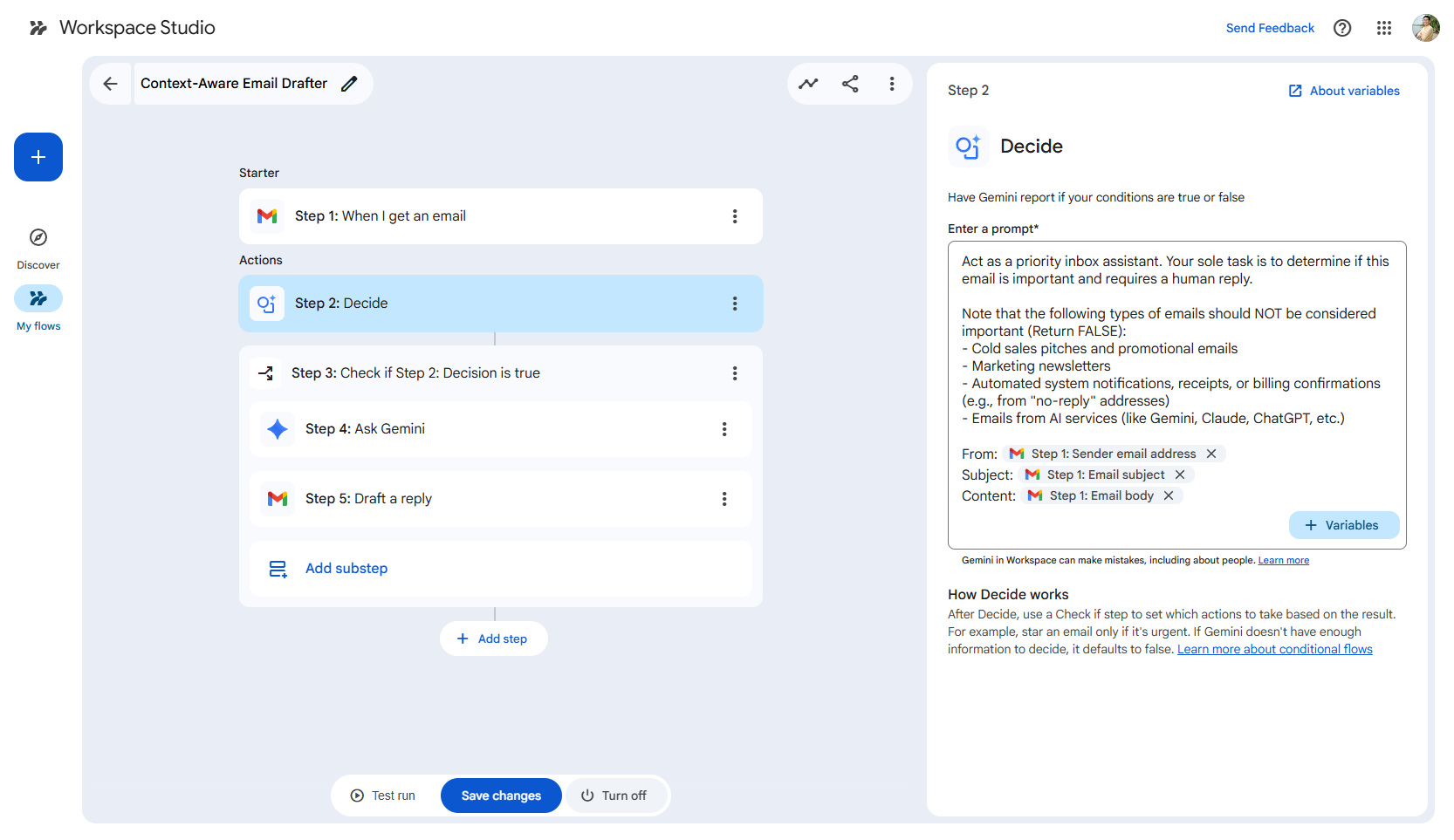
6. Building AI Workflows with Google Workspace Studio
To move beyond simple prompt engineering, we leverage Google Workspace Studio to build custom, context-aware AI workflows that autonomously handle routine agency operations. This represents a significant shift in how we work.
e.g. Context-Aware Email Drafter
Lowering the Foreign Language Barrier
FFV operates with:
Japanese-native managers
Vietnamese-native team members
7. Instant Meeting Records via NotebookLM
For meetings:
Online → Gemini auto-transcription
Offline → Upload audio to NotebookLM
We then:
Generate structured meeting minutes
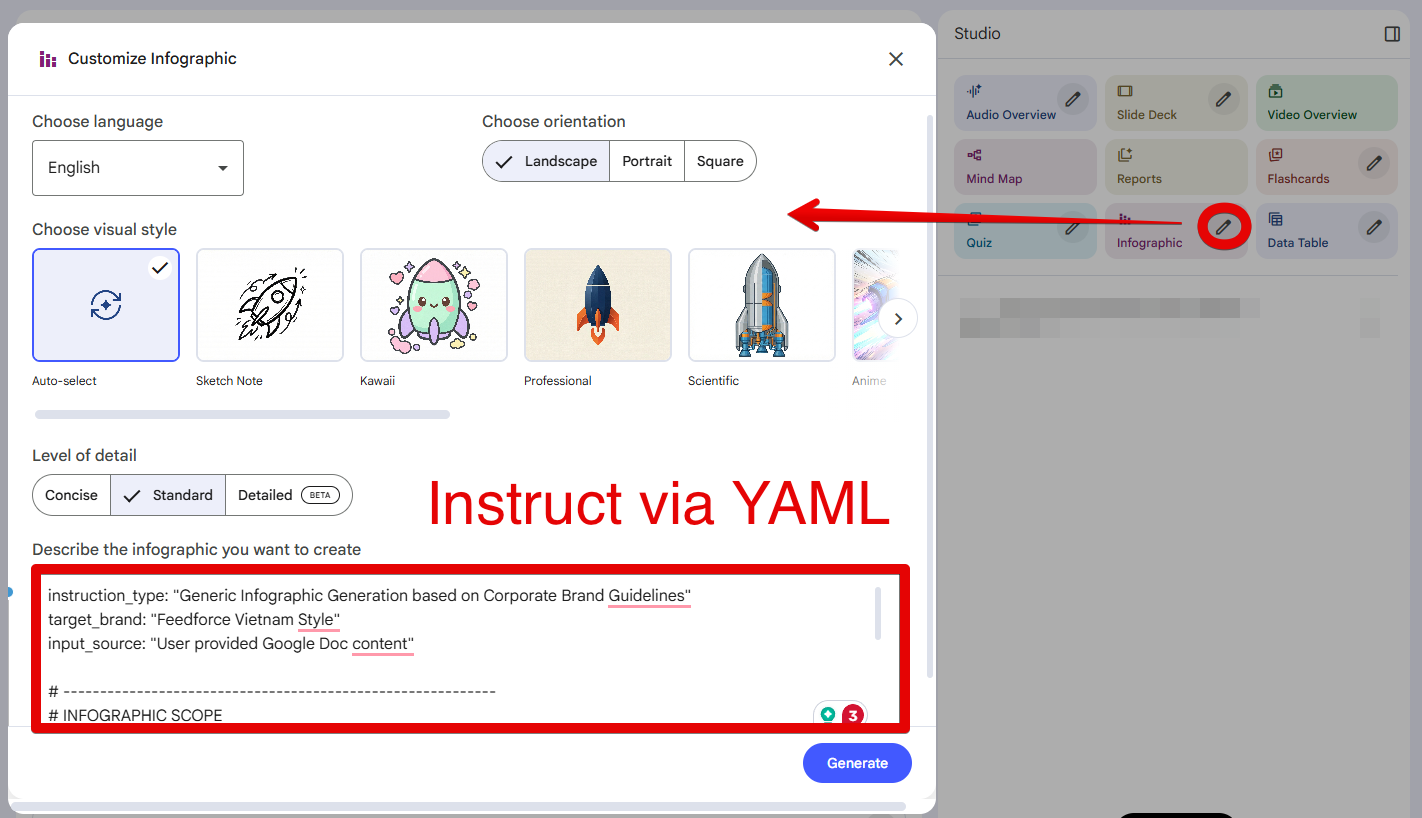
Create instant infographics
Since notebooks are shared, team members can review content in their preferred language, regardless of the meeting language.
8. Standardizing Slides & Infographics with YAML
Generative AI enables non-native speakers to create near-native-quality slides.
We:
Generate slides via Gemini, using YAML specifications to standardize:
Fonts
Colors
Layout
Typography
Tone
Export to Google Slides
instruction_type:"Generic Slide Deck Generation based on Corporate Brand Guidelines"target_brand:"Feedforce Vietnam Style"input_source:"User provided Google Doc content"# -----------------------------------------------------------# DESIGN SYSTEM# Fixed design rules to replicate the original Feedforce Vietnam profile look and feel# -----------------------------------------------------------design_guidelines:visual_tone:"Professional, Data-Driven, Clean, Trustworthy, Growth-Oriented"typography:style:"Arial (system-default sans-serif for maximum compatibility)"readability:"High contrast, minimal text density per slide, prioritized hierarchy"color_palette:primary_brand:"#6EBB44"# FFV Green (Use for headers, key emphasis, arrows)primary_text:"#131C4B"# Deep Navy (Use for main text, title slide backgrounds, footers)background_main:"#FFFFFF"# White (Standard background)accents:-"#FF8017"# Orange (Use for Call to Actions, 'Act' phase in PDCA, or Highlights)-"#04A5D5"# Light Blue (Use for secondary data points, 'Plan' phase)-"#FFC600"# Yellow (Use for icons, 'Check' phase, or notifications)-"#FEA400"# Gold (Use for achievements, rankings, or premium features)layout_preferences:# ... [content omitted for brevity] ...
Part of the YAML for creating Feedforce Vietnam slides
Using machine-friendly formats like:
Markdown
YAML
Mermaid
is essential for effective collaboration between non-engineers and AI.
With well-designed prompts, non-native speakers can produce high-quality first-draft ad copy, sometimes exceeding native-level output.
Our approach:
Provide feedback at the prompt level, not just output level
Encourage a continuous improvement cycle for prompts
Example prompt:
You are Japanese.

Use the following English copy as a reference
to generate ad text for a Japanese Meta ad.

Note that a direct translation of English into Japanese sounds very unnatural,
so make sure that the output is natural Japanese
and does not contain any unnatural words.

Your audience is also Japanese.
The ad copy must be perceived as natural and thought up by a Japanese person.

Also, your audience must never realize that the ad copy
is Japanese translated from English or created by a generative AI.

Take your time and think carefully.

### English copy:
{English copy}
This ensures:
Natural language output
Cultural alignment with the target audience
10. ChatGPT as a Support Tool (Second Opinions & Translation)
Although Google AI is our primary tool, we use ChatGPT and Claude for:
Second opinions on simple research
Explaining concepts in Vietnamese when English is insufficient
Simplifying high-context English feedback
This helps bridge understanding across languages and contexts.
Back Office & Management
11. Custom Attendance & Communication Tools
We "vibe-coded" lightweight internal tools using AI (GAS + Slack APIs):
Attendance tracking via Slack messages → Google Sheets
Aggregating Slack + Notion data → Google Drive for AI processing
This approach is cost-efficient and tailored to our needs.
12. Man-Hour Calculation via Google Calendar
Due to Vietnamese accounting requirements, we must track time allocation by project.
Workflow:
Tasks taking 15 minutes or more are logged in Google Calendar
Gemini reads Google Workspace data
Time allocation is automatically calculated by the project
Purpose:
Ensure compliance with accounting requirements
Reduce manual time tracking effort
Improve accuracy in resource allocation
Additional AI Tools We Explore
We also experiment with:
Grok → research individuals who are active on X (Twitter) before meetings
Various Chinese AI models (noted for richer context when processing Vietnamese websites)
We are still in the experimentation phase, continuously updating and refining our AI stack while actively evaluating and integrating new tools into our workflow.
Closing Thoughts
Generative AI is no longer just a productivity tool—it is the foundation for future organizational transformation and the key to redefining our core value proposition as an agency.
By combining:
Multilingual workflows
Context-rich AI agent configurations
Workspace-integrated AI
We aim to:
Go beyond basic operational efficiency to deliver deeper strategic insights
Eliminate cross-border communication friction
Build a scalable, AI-native organization that fundamentally elevates client success
GA4 engagement rate and bounce rate are often misinterpreted because they no longer mean what they did in Universal Analytics. This guide breaks down GA4’s exact definitions, explains when a high bounce rate is completely normal, and shows how to use these metrics to make smarter marketing and UX de
High CPM, unstable CPA, and no conversions after 1–3 days? Before you kill the campaign, understand the Learning Phase. Here’s how Meta learns, what the 50-conversion guideline actually implies, and the setup changes that stabilize performance instead of resetting learning.




.png)
.png)
.png)
.png)
.png)
.png)
.png)


