


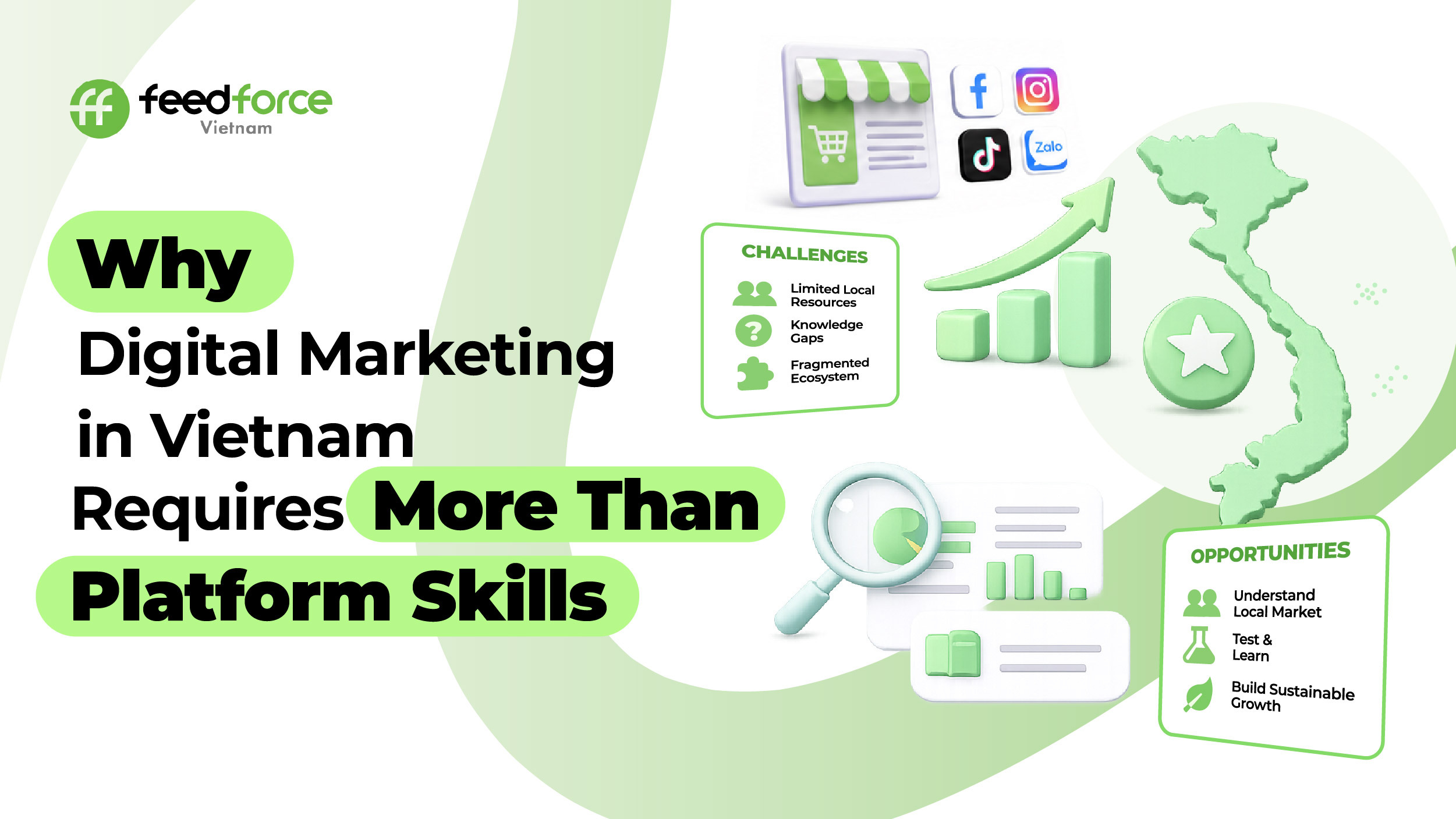
Vietnam's digital marketing market is growing fast, but structural challenges remain: fewer local benchmarks, limited resources, and less senior talent. Platform skills alone are not enough. Business thinking is what creates real advantage.

For more than two decades, Search Engine Optimization (SEO) has been the foundation of organic marketing strategies. Brands have competed for visibility on Google's first page through keyword optimization, content creation, and backlink building.
However, the rise of AI-powered search platforms such as ChatGPT, Gemini, or Copilot is fundamentally changing how people search for information. Instead of visiting multiple websites and piecing together answers themselves, users are increasingly turning to AI tools for direct, comprehensive responses.
This shift has given rise to a new discipline: Generative Engine Optimization (GEO).
There are many new terms in the AI Search world. Here is a simple explanation:
These disciplines are not competing with each other. Instead, they represent different layers of the modern search ecosystem.
Strong SEO creates the foundation for discoverability, GEO expands this further by helping AI systems recognize your content as reliable and useful enough to cite or recommend.
AEO complements both SEO and GEO by ensuring that content directly answers common user questions in a clear, structured format. Meanwhile, AIO focuses more specifically on visibility within AI-generated search experiences.
The core principle remains the same: create high-quality, accurate, authoritative, and well-structured content that provides real value to users. GEO does not replace SEO. It extends SEO into the AI Search era.
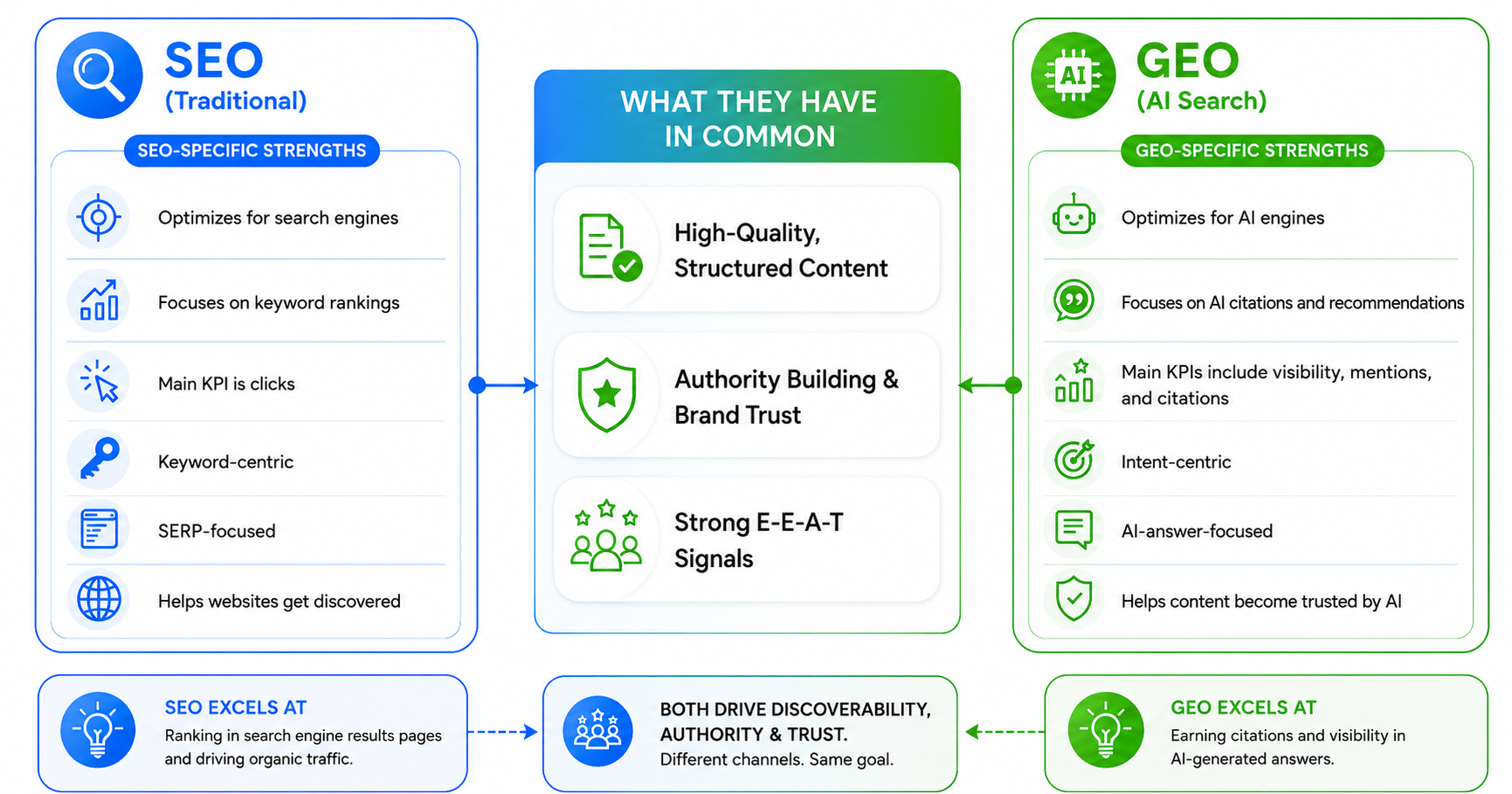
Generative Engine Optimization (GEO) is the practice of optimizing content so that AI-powered search engines, assistants, and large language models can accurately understand it.
For example, when a user asks:
Rather than presenting a list of links, AI systems often generate a direct answer by synthesizing information from multiple trusted sources.
GEO focuses on increasing the likelihood that your brand, website, research, product, or content becomes one of those trusted sources. The stronger your authority, expertise, and content quality signals, the more likely AI systems are to reference and recommend your information when generating responses.
In the AI Search era, success is no longer measured solely by rankings and clicks. Increasingly, it is also measured by whether AI systems recognize your content as authoritative enough to cite, summarize, and recommend.
In the past, users often searched with short keywords such as:
SEO agency Vietnam
Now, users may ask a full question like:
Which SEO agency is suitable for a small B2B company in Vietnam?
How can a SaaS startup improve organic traffic without increasing ad spend?
As search becomes more conversational, brands must create content that directly answers real user questions rather than simply targeting isolated keywords.
Content that provides clear, complete, and context-rich answers is more likely to be surfaced by AI search engines and cited in generated responses.

AI-generated answers are accelerating the rise of zero-click search—a behavior where users receive the information they need directly within a search engine or AI interface without clicking through to a website.
This trend became even more significant following the announcements at Google I/O and Google Marketing Live in May 2026, where Google reinforced its vision for an AI-First Search experience. The updates signal a clear shift from traditional search engines that primarily return links to AI-powered systems that generate direct answers, summaries, recommendations, and insights.
As AI Overviews, AI Mode, and conversational search experiences become more prominent, users increasingly interact with answers rather than navigate between multiple webpages.
For brands, this means ranking on Google is no longer the only objective.
Businesses must also optimize for visibility within AI-generated responses, ensuring their content can be understood, trusted, cited, and recommended by AI systems.
In the age of AI Search, success is no longer measured solely by clicks and traffic. It is increasingly influenced by how often a brand is mentioned, referenced, and surfaced within AI-generated answers.
The challenge is no longer just winning the click—it is becoming part of the answer.
AI tools are becoming a new starting point for discovering brands, products, services, and solutions.
Just as users once relied mainly on Google to begin their research, they are now using AI assistants to compare options, understand problems, and make decisions.
For example, a user may ask:
If AI frequently mentions a brand in its answers, that brand gains stronger awareness, credibility, and consideration.
This is why GEO is becoming increasingly important for businesses that depend on organic visibility.
To improve GEO (Generative Engine Optimization) performance, businesses must understand the signals AI systems use when selecting content as a trusted source.
AI platforms are more likely to reference content that demonstrates deep subject-matter expertise.
Rather than publishing superficial articles designed solely around keywords, businesses should create content that provides meaningful insights, practical guidance, and real-world examples.
The more useful and informative the content, the more likely AI systems are to view it as a reliable reference.
Trustworthiness is one of the most important factors in AI content selection.
AI models tend to favor content that is accurate, transparent, current, and supported by credible evidence. Brands should avoid vague claims and instead provide verifiable information backed by data, research, or practical experience.
Ways to strengthen content trust signals include:
The stronger the trust signals, the higher the likelihood that AI systems will reference the content in generated responses.
AI systems prefer content that is well-organized and easy to interpret.
A clear structure helps AI identify key concepts, extract answers, and understand relationships between ideas.
Well-structured content improves both user experience and AI comprehension.
AI search engines often prioritize sources that provide complete coverage of a subject.
Rather than answering a single question in isolation, comprehensive content explores related concepts, common concerns, practical examples, and supporting context.
The more complete the coverage, the greater the chance that AI systems will view the content as an authoritative resource.
As AI-powered search continues to evolve, businesses must adapt their content strategies to improve discoverability and citation potential. The following GEO tactics can help brands increase their presence in AI-generated responses.

AI systems assess expertise at both the page and domain level.
Rather than publishing disconnected articles across unrelated subjects, businesses should develop content clusters around their core areas of expertise.
This helps AI systems recognize the brand as a credible authority within a specific knowledge domain.
Modern search behavior is increasingly conversational.
Users no longer search only with short keywords. Instead, they ask detailed questions and expect direct answers.
Question-focused content aligns naturally with how AI systems generate responses and answer user queries.
E-E-A-T stands for: Experience, Expertise, Authoritativeness, Trustworthiness.
Although E-E-A-T is commonly discussed in SEO, it is also highly relevant to GEO.
Businesses can strengthen E-E-A-T by adding:
This helps both users and AI systems trust the brand’s content.
FAQ sections are particularly valuable for GEO because they present information in a straightforward question-and-answer format.
This structure makes it easier for AI platforms to identify, extract, and reuse relevant information when generating responses.
Effective FAQs should address:
Well-written FAQs can significantly improve a page's chances of being cited by AI search engines.
AI systems process structured information more efficiently than long blocks of text.
Organizing information into clear frameworks improves readability and makes key insights easier to extract.
Structured content can include:
The easier your content is to interpret, the more likely it is to be referenced in AI-generated answers.
In traditional content marketing, success is often measured by:
In the age of AI Search, new metrics will become more important, including:
This means the goal of content marketing is changing.
It is no longer only about bringing users to a website. It is also about becoming a trusted source that AI systems are willing to recommend.
GEO is becoming one of the most important trends in organic marketing.
As AI Search changes how people discover information, businesses need to rethink their content strategy. The future of organic content is not only about ranking on Google. It is also about being trusted, cited, and recommended by AI.
SEO remains an essential foundation for both local brands and foreign companies entering the Vietnamese market. As discussed in our guide on combining organic search and paid advertising for sustainable growth, strong organic visibility continues to play a critical role in building long-term brand presence. GEO, however, adds a new competitive advantage by helping brands increase their visibility within AI-powered search experiences.
Brands that invest early in high-quality content, topical authority, expert insights, and structured information will be better positioned to win visibility in the age of AI Search.
Related Articles
Vietnam's digital marketing market is growing fast, but structural challenges remain: fewer local benchmarks, limited resources, and less senior talent. Platform skills alone are not enough. Business thinking is what creates real advantage.
June 4, 2026
AI is changing how digital marketing teams work in Vietnam. This article explores how AI reduces manual tasks while increasing the importance of judgment, quality control, business understanding, and client-focused strategy.
June 18, 2026


