Product First: The Mindset That Helps You To Scale Sales
In the 4P framework, Product comes first. Not by accident: the other three are decisions you make about something. Remove the Product and there is nothing left to price, place, or promote.
Yet when a team says "we need to do more marketing," they almost never mean Product. They mean running ads, booking KOL/KOC, going live on TikTok, posting more on social. All of that is Promotion: one P out of four, doing the job of all four.
We are a digital marketing agency. Promotion is what clients pay us for. So it may sound strange coming from us, but here is what we see again and again: the ad account is rarely the reason a brand stops growing. In this article, we'll look at what Vietnamese consumer data actually says about when a buying decision is made, and why "Product First" is a growth strategy, not a philosophy.
1. "Marketing" has quietly become a synonym for "Promotion"
Ask ten business owners in Vietnam what their marketing budget is, and nine will answer with an ad spend number.
This makes sense. Promotion is the most visible P. It has dashboards, daily numbers, and a clear person to blame. However, product decisions are slower, harder to measure, and usually sit with a different team, or with a factory in another country.
There is also a structural reason. In most foreign brands operating here, the Vietnam team owns the media budget but not the product roadmap. Pricing, packaging size, formulation, and assortment are decided at headquarters, often a year in advance. So when sales are flat, the local team optimizes the only lever it is actually allowed to pull: the campaign. The real constraint sits somewhere no one in the meeting has permission to touch.
The cost of this habit is subtle. The conversation starts at the channel instead of the offer. A brief that begins with "we need to increase the Meta budget" has already skipped the more useful questions: which product, at what price, against which competitor, for which buyer. By the time anyone asks "is this product right for Vietnam?", the campaign is already live and the budget is already committed.
2. Where the product quietly takes over
Vietnamese consumers are not loyal by default. As we wrote in 10 Costly Marketing Mistakes Foreign Brands Make in Vietnam, shoppers here re-evaluate their options almost every time they buy, checking reviews, prices, and alternatives again from scratch. Subscription and habit-based repurchase are far less common than in Korea, Australia, or Indonesia.
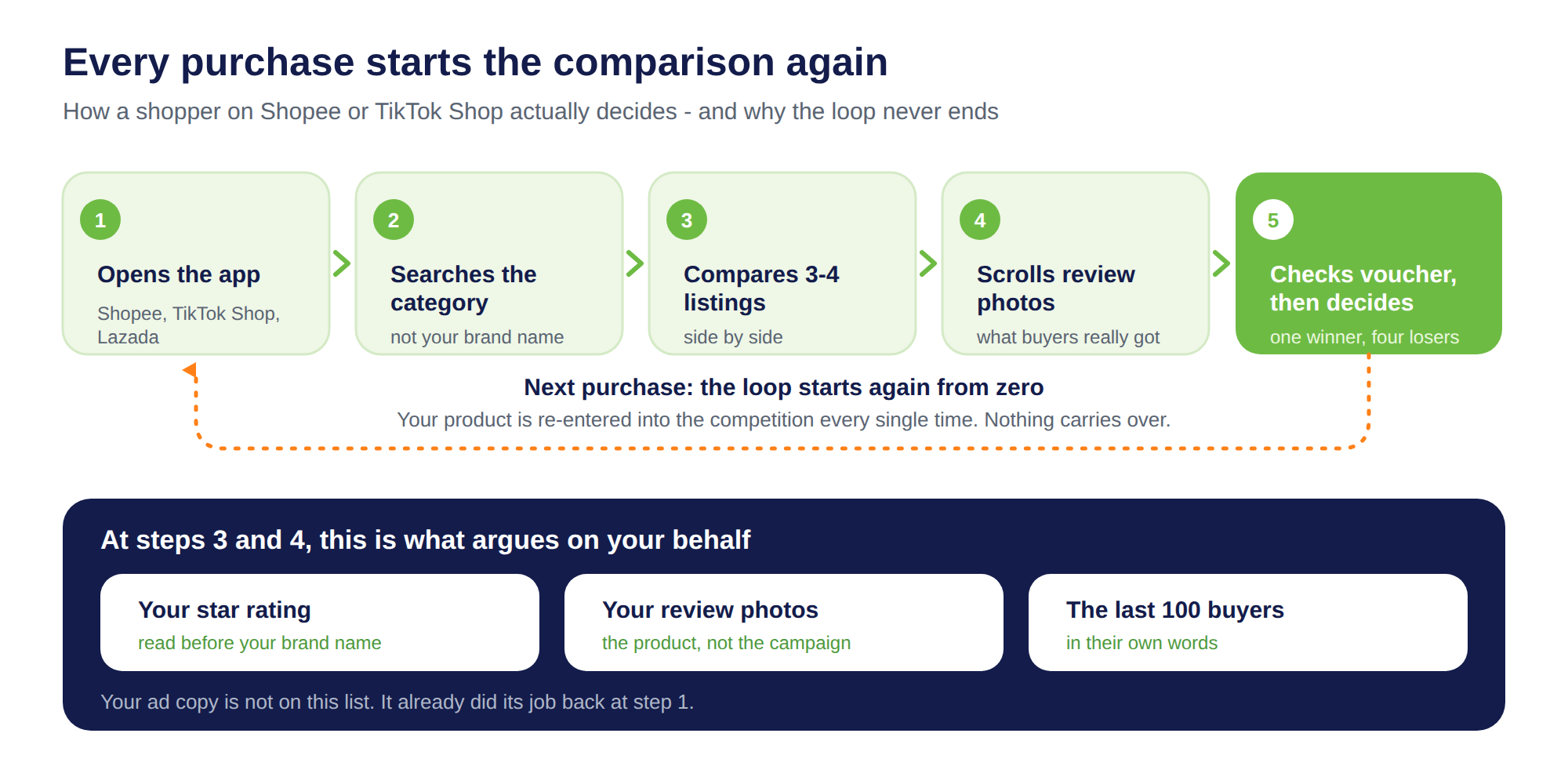
It helps to picture the actual loop. A shopper opens Shopee or TikTok Shop, searches the category rather than your brand name, compares three or four listings side by side, scrolls the review photos, checks the current voucher, and only then decides. That loop runs again on the next purchase. Your product is re-entered into the competition every single time, and the thing arguing on your behalf is not your ad copy. It is your rating, your review photos, and what the last hundred buyers said about you.
Vietnam shopper re-evaluation loop
That means every repeat purchase must be re-earned by the product itself, and it means your reviews are doing more selling than your ad copy.
Three data points make the same argument from different directions:
Where consequences are real, price stops working:Q&Me found that 69% of urban Vietnamese consumers have bought a counterfeit product. Of those, 87% bought fake clothing and 69% fake footwear. But in cosmetics, food, and supplements, fakes are rejected by the vast majority regardless of how low the price is. The same study found shoppers lean on QR codes and official stores (both 69%) to verify authenticity, and treat an unusually low price as a warning sign rather than a bargain. When a bad product can actually hurt you, no discount and no creator can sell it.
Perceived product quality is itself a demand driver: In a Q&Me study of 202 consumers in Ho Chi Minh City and Hanoi, Japan ranked highest on country-of-origin image at 93% positive, scoring 81% on quality and 78% on trustworthiness. China was the only origin with meaningful negative associations: cheap (23%), untrustworthy (17%), copycat (15%). That gap was not created by an ad campaign. It was built by decades of products behaving the way they promised. If you carry that reputation, your product is doing marketing work before you spend any money, and if you damage it, no budget buys it back quickly.
Price-sensitive does not mean price-only:PwC's 2025 Voice of the Consumer survey found 47% of Vietnamese consumers name price as the main driver when choosing food, but 41% say they would pay a premium for locally produced food, and 74% report being highly concerned about ultra-processed ingredients. Vietnamese shoppers are careful with money, not indifferent to quality. A product attribute they believe in can still beat a cheaper alternative.
3. Marketing is not the problem: it is the multiplier
To be clear, we are not saying "build a good product and customers will come." That is a comfortable lie, and it kills good products quietly. Vietnam is a discovery market, and discovery is bought.
71% have bought a product directly through a social platform (versus 56% across Asia Pacific)
58% have been persuaded by an influencer to make a purchase
But notice what those numbers describe: they are all about the first purchase. Promotion is excellent at producing a first purchase. It has almost no power over the second one.
Therefore, it is worth being precise about the division of labor:
Promotion can create awareness, bring qualified traffic, explain a benefit, remove a hesitation, and time a purchase to a voucher window.
Promotion cannot make a product work, make a price feel fair, fix a delivery experience, or convince someone who has already been disappointed once.
4. Good marketing makes a weak product fail faster
This is the part we believe most strongly, and it is not the comfortable version.
Most people assume a weak product with strong marketing gets an average result. In Vietnamese e-commerce, we think it gets a worse result than a weak product with no marketing at all.
Here is why. Ads can buy reach. Reach can buy first purchases.
And on Shopee or TikTok Shop, a first purchase of a disappointing product does not just end there. It becomes a 1-star review, a return request, a complaint in the comments, an unboxing video with a bad ending. Those signals are permanent, public, and indexed. They sit on your listing next to the price, they show up in search results, and they are the first thing the next shopper reads.
The damage compounds in two ways at once:
Human: Your conversion rate falls, because every new visitor now arrives to a wall of warnings written by people who paid their own money.
Algorithmic: Shopee Vietnam puts numbers on this. Under its seller penalty point system, a non-fulfillment rate of 10% or more earns a penalty point, and accumulated points suspend seller privileges for 7 to 28 days depending on the level: 3 to 5 points means a ban from Shopee campaigns and locked ad tools, and restricted product visibility starts at 6. Separately, its product quality rule removes a product from the store entirely once its weekly 1-2 star review rate reaches 20% (calculated per product each week, for products with at least 15 completed orders and at least 3 one- or two-star reviews in that same week). Poor post-purchase signals do not just cost you conversions; they cost you the promotional tools you would use to fix the problem.
So scaling spend on a weak product does not buy you growth. It buys you a faster, better-documented, algorithmically-punished failure. Good marketing on a weak product just helps more people find out it's weak, sooner.
The same mechanism runs in reverse, and that is the real argument for Product First. A good product turns paid reach into reviews, ratings, word of mouth, and organic recommendation: assets that keep working after the budget stops. Marketing is a multiplier. It multiplies whatever the product already is.
5. What "Product First" looks like in practice
You do not need to redesign your product to apply this. Start from these 3 simple steps:
Read your 1-3 star reviews as research, not complaints: They are the cheapest and most honest product feedback available in this market. Group them by reason (wrong expectation, quality issue, delivery, sizing, missing information) and you will usually find that two or three fixable causes explain most of them. Some are content problems, not product problems, and those you can solve this week.
Add repeat purchase rate to your reporting: If you only look at ROAS, you will never see the difference between a product that works and a product that sells once. A campaign with lower ROAS but higher repeat rate is often the more profitable one.
Product and Promotion are not competing budgets. A good product with weak marketing grows slowly. Good marketing on a weak product burns money and leaves a public record of it. Only the two together create a business that is both successful and resilient.
The practical version of "Product First" is not a philosophy about craftsmanship. It is a sequencing decision: make sure the product can hold the customers your ads bring in, then spend to bring in more of them. Ads can bring people to your product. Only the product can make them come back.
If you are deciding where your next money should go, product or promotion, that is the sequencing question we work through with our clients. Contact us here.
The product detail page is where buying decisions are made or lost. Many brands overlook its importance, leading to missed conversions. Learn how to fix common PDP mistakes, build trust, and create seamless, mobile-friendly experiences that drive sales.
Many foreign brands enter Vietnam with strong intentions but stumble by misapplying global strategies. From ignoring local buying habits to vague KPIs, this article reveals 10 common mistakes—and how to avoid them for smarter, faster growth in Vietnam.
GMV Max is TikTok Shop’s automated ad solution that optimizes for ROI, but success depends on product depth, creative velocity, and operational readiness. This article explains how GMV Max works in practice, when to use it, and the common pitfalls that limit scale.