How to Measure E-commerce Performance When Tracking Is No Longer Perfect




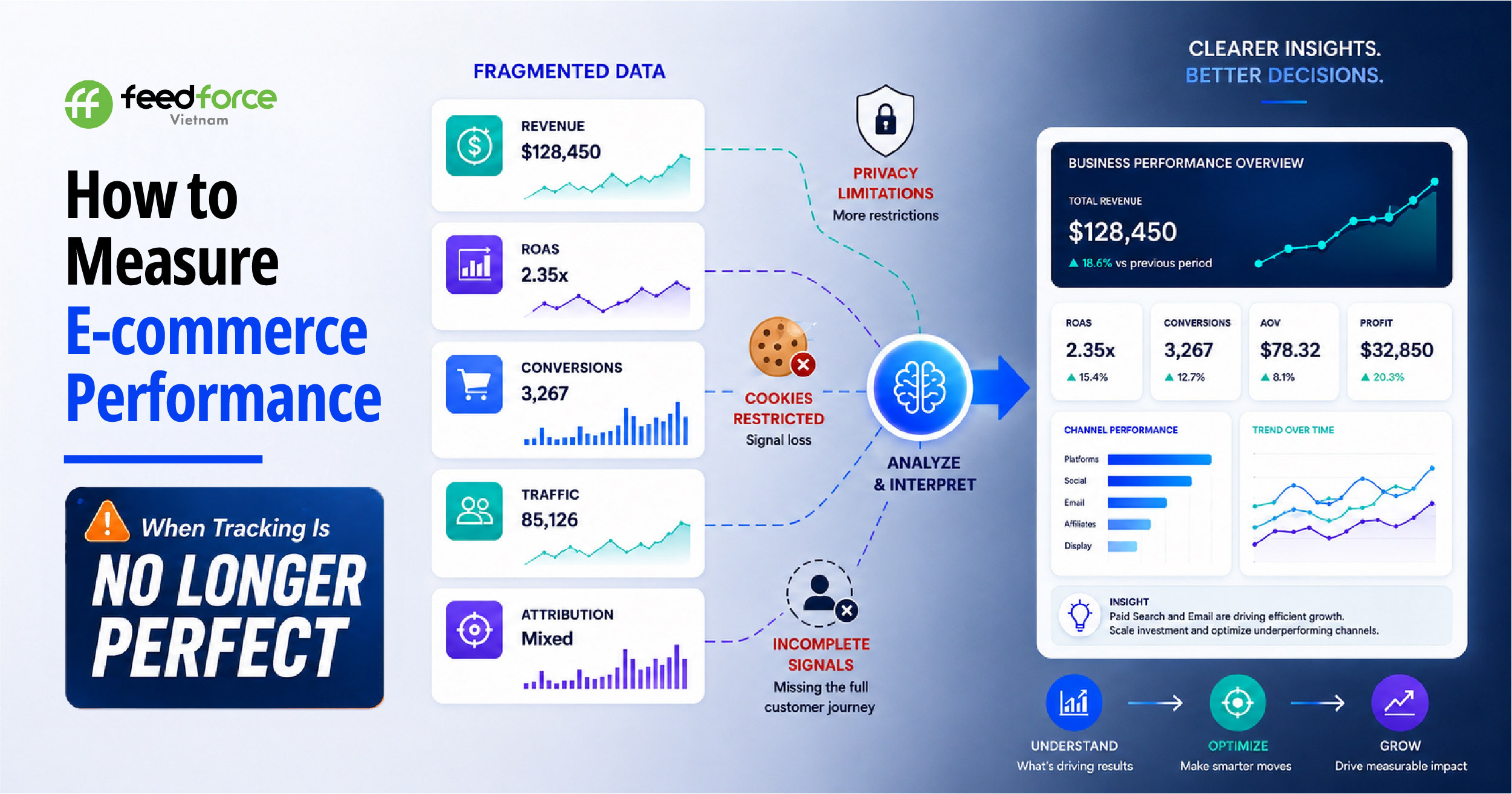
Introduction: E-commerce Tracking Is No Longer Complete
If you manage paid media for an e-commerce business, you have probably seen this situation before.
Shopify shows one revenue number. GA4 shows another. Meta Ads reports a different amount. Google Ads shows its own conversion value.
At first, this may look like a tracking error. But in many cases, the issue is more complex than one broken tag or one missing parameter.
The digital marketing environment in Vietnam is changing rapidly. Alongside global developments such as browser restrictions, iOS privacy controls, ad blockers, and platform-level modeling, businesses must also respond to Vietnam’s evolving data-protection framework. Decree No. 13/2023/ND-CP established requirements for personal data protection, while the Law on Personal Data Protection No. 91/2025/QH15 further strengthens the responsibilities of organizations that collect, process, and use customer data.
Through hands-on experience managing paid media for Vietnamese and international brands in Vietnam, FFV has seen how consent settings, incomplete tracking signals, and inconsistent platform data make campaign measurement increasingly complex. Addressing these challenges requires local market knowledge, technical coordination, and careful performance interpretation. That is why FFV can be a reliable partner for brands seeking up-to-date expertise and practical support in navigating an increasingly complex digital marketing landscape.
For e-commerce marketers, this creates a new challenge.
The goal is no longer to find one perfect number that explains every customer journey. The goal is to understand what each data source can and cannot tell us, then turn imperfect data into better business decisions.
Main idea: As privacy changes make tracking less complete, marketers need to move from perfect attribution to decision-ready reporting.
What Is Perfect Attribution?
Perfect attribution is the idea that marketers can identify exactly which ad, click, campaign, channel, or touchpoint caused every purchase.
In theory, perfect attribution tries to answer questions like:
- Which campaign generated this exact order?
- Which ad should receive full credit for the sale?
- Which click caused the customer to convert?
- Which channel should we scale based on reported ROAS (Return on Ad Spend)?
This was already difficult before privacy changes. Customer journeys have always been multi-touch. A customer may discover a product on social media, search for the brand later, compare prices, revisit the website from email, and then purchase directly.
But today, privacy changes make perfect attribution even harder.
Some users reject cookies. Some browsers limit tracking. Some apps require tracking permission. Some conversions are modeled instead of directly observed. Some platform data is delayed, partial, or interpreted differently.
That is why marketers should be careful when treating platform attribution as the full truth.
What Privacy Changes Are Making Tracking Less Complete?
Privacy changes are not only a legal or compliance topic.
They directly affect how marketers measure campaign performance, optimize paid media, build retargeting audiences, and explain ROAS.
1. Cookie Restrictions
Cookies help websites and platforms recognize users, connect sessions, and attribute conversions.
When cookies are blocked, deleted, limited, or rejected, platforms may lose part of the customer journey.
This can affect:
- Conversion tracking
- Remarketing audiences
- Attribution windows
- User journey analysis
- Frequency control
- Cross-session measurement
For e-commerce brands, this means a customer may still purchase, but the platform may not fully connect that purchase back to the original ad interaction.
2. Consent Banners and Cookie Consent
Many websites now ask users whether they accept or reject analytics and advertising cookies.
When a user declines consent, analytics and advertising platforms may collect less data. This can affect GA4 reports, Google Ads conversion tracking, Meta Ads attribution, and remarketing audience size.
This does not mean consent banners are bad. They are part of a privacy-first digital environment.
However, marketers need to understand that user consent choices directly affect reporting completeness.
3. iOS Privacy Changes
Apple’s App Tracking Transparency framework gives users more control over whether apps can track their activity across other companies’ apps and websites.
For e-commerce advertisers, this can reduce the visibility of app-to-web journeys, especially when users discover products through social platforms and later convert on a website.
This is one reason why paid social reporting became more difficult in recent years.
4. Browser Privacy Settings and Ad Blockers
Some browsers limit tracking by default. Some users also install ad blockers that prevent pixels, tags, or scripts from firing properly.
This means that even if a website’s tracking setup is technically correct, some events may still not be captured.
For example, a customer may view a product, add it to cart, and complete a purchase, but one or more tracking events may not be sent to the analytics or ad platform.
5. Modeled Conversions and Estimated Data
As direct tracking becomes less complete, platforms increasingly rely on modeling to estimate missing data.
Modeled data can help marketers maintain useful reporting and optimization signals, but it also changes how performance should be interpreted.
Important note: Not every number in a marketing dashboard is purely observed. Some numbers may include modeling, estimation, or platform-specific attribution logic.This is why marketers need to understand how data is collected, not just what the dashboard shows.
How Privacy Changes Affect Paid Media Performance
Privacy changes do not only affect reporting. They also affect paid media performance because ad platforms rely on conversion signals to optimize delivery.
When tracking becomes less complete, the algorithm may receive weaker signals. This can influence campaign learning, audience quality, bidding, and budget decisions.
1. Lower Reported Conversions
One of the most common effects is lower reported conversions inside ad platforms.
A purchase may still happen in the e-commerce backend, but Meta Ads or Google Ads may not receive enough data to attribute that purchase correctly.
As a result, platform-reported ROAS may decline even when actual store revenue remains stable or continues to grow.
This creates a risk: marketers may reduce budget from campaigns that are still contributing to business results, simply because the platform cannot fully attribute the conversion.
2. Less Stable ROAS
ROAS can become more volatile when platforms receive fewer directly observed conversion signals.
A campaign may look strong one week and weak the next, even if the overall business trend has not changed significantly.
This is especially important for e-commerce brands running short promotion campaigns, seasonal campaigns, or product-launch campaigns.
When attribution is less stable, marketers should avoid making major budget decisions based only on short-term platform ROAS.
3. Smaller Retargeting Audiences
Retargeting depends on the ability to identify users who visited the website, viewed products, added items to cart, or started checkout.
When tracking is blocked or limited, fewer users may enter these audiences.
This can reduce the scale of:
- Dynamic product ads
- Product viewer retargeting
- Add-to-cart retargeting
- Abandoned checkout campaigns
- Returning visitor campaigns
Retargeting can still be valuable, but marketers should not expect the same level of audience completeness as before.
4. Weaker Algorithm Learning Signals
Meta Ads, Google Ads, TikTok Ads, and other platforms need conversion data to optimize campaign delivery.
If purchase events are missing, duplicated, delayed, or incomplete, the algorithm may have less reliable data to learn from.
This can affect:
- CPA (Cost per Acquisition) stability
- ROAS stability
- Budget scaling
- Campaign learning phase
- Product-level optimization
- Audience expansion quality
For e-commerce brands, clean event tracking is not only a reporting issue. It is also a performance issue.
5. More Reporting Confusion
Privacy changes have also made reporting harder to explain.
Business owners and internal teams may ask:
- Why does Shopify show more revenue than GA4?
- Why does Meta Ads show fewer purchases than the store backend?
- Why does Google Ads claim conversions that GA4 does not show in the same way?
- Which number should we trust?
- Is paid media really working?
This is where the marketer’s role becomes more strategic.
A good marketer should not only export dashboards. A good marketer should explain what each data source means, where the gaps are, and what decision can be made from the available data.
Why Shopify, GA4, Meta Ads, and Google Ads Data No Longer Match
A common mistake is expecting Shopify, GA4, Meta Ads, and Google Ads to show the same revenue number.
In reality, each platform has a different role.
Why the Numbers Are Different
The numbers may differ because of:
- Different attribution windows
- Different conversion definitions
- Different time zones
- Different consent settings
- Different event firing logic
- Different deduplication rules
- Different click-based and view-based attribution
- Different refund handling
- Different modeled conversion logic
- Different ways of assigning credit to channels
The question should not be:
Which platform is perfectly correct?
The better question is:
What is each platform useful for, and what decision can we make from it?
From Perfect Attribution to Decision-Ready Reporting
In a privacy-first marketing environment, perfect attribution is no longer the best goal.
Perfect attribution tries to prove exactly where every conversion came from.
Decision-ready reporting focuses on whether the business has enough reliable signals to make the next move.
That next move could be:
- Increasing budget
- Reducing wasted spend
- Fixing tracking issues
- Improving creative testing
- Optimizing product feeds
- Adjusting campaign structure
- Reviewing landing pages
- Changing promotion strategy
- Separating always-on campaigns from short-term sale campaigns
Decision-ready reporting does not ignore data gaps. It makes those gaps visible and manageable.
It helps teams understand:
- What happened
- Why it may have happened
- How confident we are in the data
- What action should be taken next
This is the reporting mindset e-commerce brands need today.
A Practical Decision-Ready Reporting Framework for E-commerce
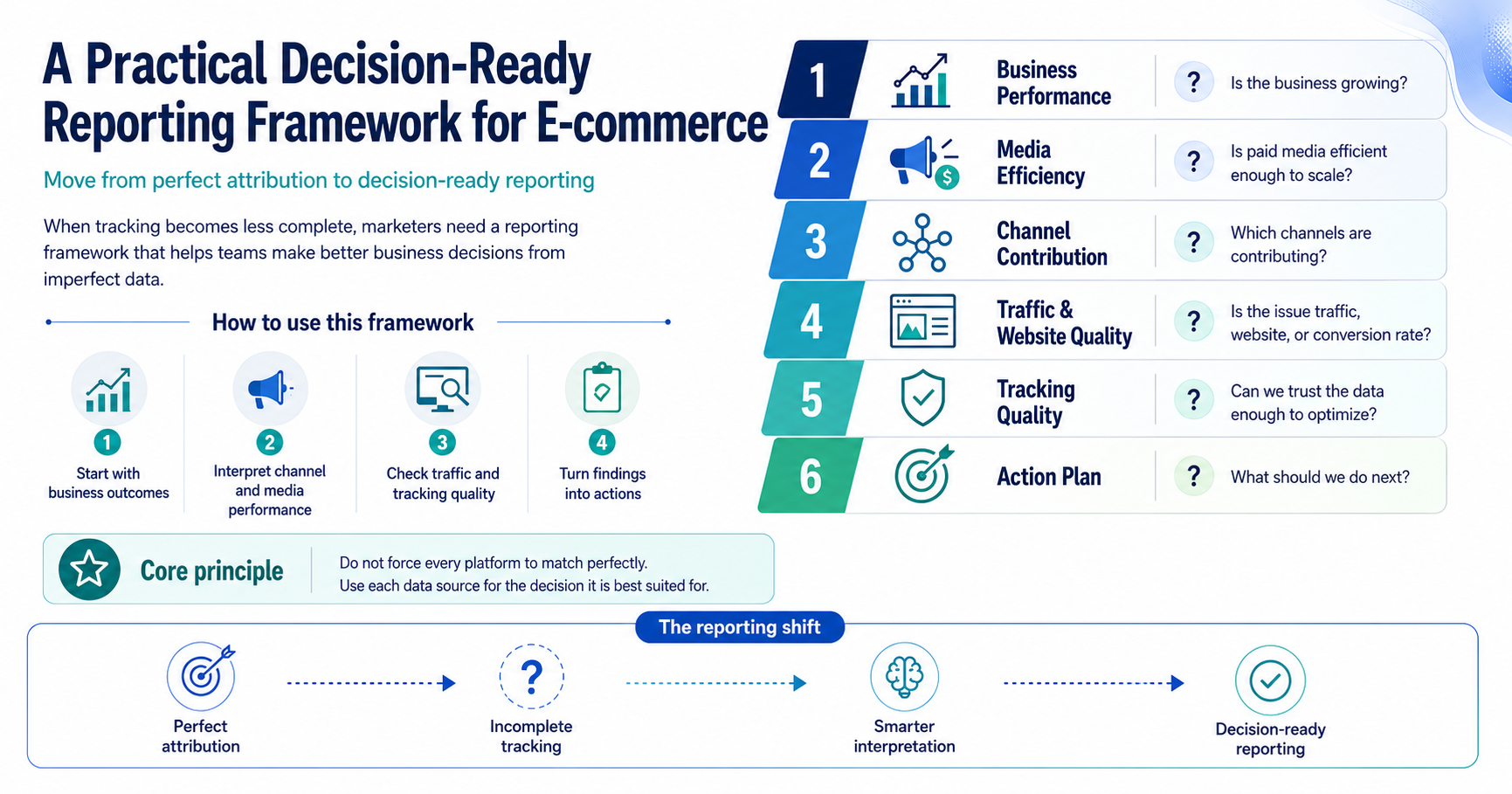
To build decision-ready reports, marketers should combine multiple layers of analysis instead of relying on one platform number.
Example: How to Read Different Revenue Numbers Across Platforms
Imagine an e-commerce brand sees the following data in one month:
SourceReported RevenueHow to Read ItShopify600M VNDActual store revenueGA45400M VNDWebsite-tracked analytics revenueMeta Ads360M VNDMeta-attributed revenueGoogle Ads180M VNDGoogle-attributed revenue
A perfect attribution mindset asks:
Why do these numbers not match?
A decision-ready reporting mindset asks:
- Is total store revenue growing?
- Is paid media spend efficient?
- Are Meta and Google still driving qualified traffic?
- Are conversion signals strong enough for optimization?
- Are there tracking issues that need fixing?
- What action should we take next?
The marketer should not choose one number and ignore the rest.
Instead, each source should be used for the decision it is best suited for.
Shopify should answer whether the store generated sales. GA4 should help explain website behavior and traffic quality. Meta Ads should show how Meta campaigns performed within Meta’s attribution system. Google Ads should show how Google campaigns performed within Google’s attribution system.
Together, these sources create a more useful view than any single dashboard alone.
What E-commerce Brands Should Do to Adapt
Privacy-first marketing does not mean marketers are powerless. It means brands need stronger data foundations and better reporting logic.
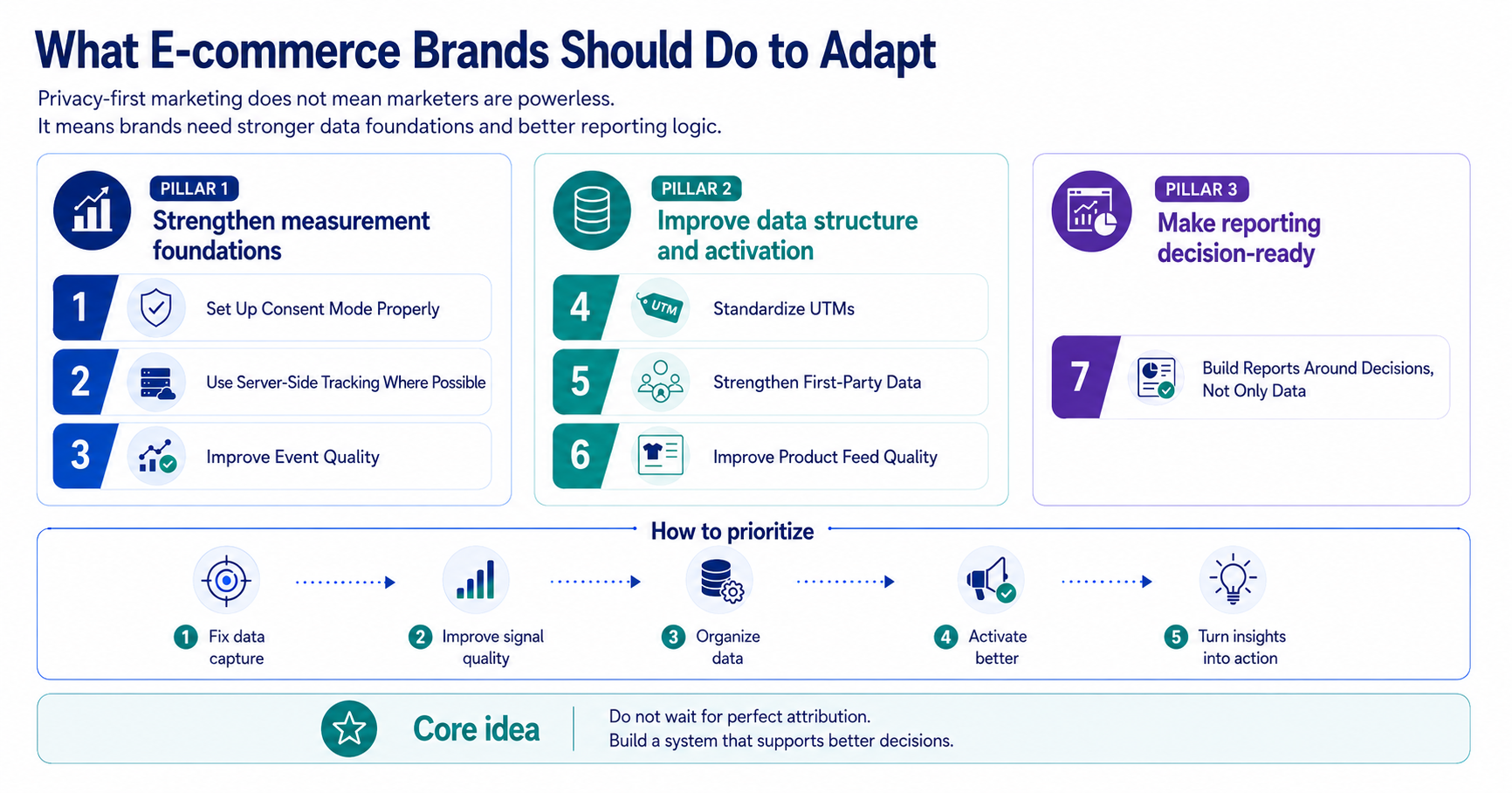
Navigating paid media in a privacy-first environment requires more than running ads. It requires a clear understanding of tracking limitations, platform attribution, product data, campaign optimization, and business-level reporting. With hands-on expertise across e-commerce and paid media operations, FFV can support your brand in managing these complex processes and building a reporting system that leads to better marketing decisions.
Common Mistakes Marketers Should Avoid
Mistake 1: Treating One Platform as the Full Truth
No single platform sees the full customer journey.
Shopify, GA4, Meta Ads, and Google Ads each have different roles. Treating one platform as the complete truth can lead to poor decisions.
Mistake 2: Judging Campaigns Only by Short-Term ROAS
ROAS can fluctuate because of attribution windows, conversion delay, promotion timing, seasonality, product availability, and tracking limitations.
Short-term ROAS should be reviewed together with broader business trends and supporting metrics.
Mistake 3: Ignoring Tracking Health
If purchase events are missing, duplicated, or poorly matched, platforms receive weaker signals.
Tracking health should be reviewed regularly, especially after website changes, checkout changes, app changes, feed changes, or campaign structure changes.
Mistake 4: Reporting Data Without Context
Clients and business teams do not only need numbers. They need interpretation.
A useful report should explain why the numbers differ, what can be trusted, what needs investigation, and what action should be taken.
Mistake 5: Expecting Every Platform to Match
Small differences between platforms are normal. Large differences should be investigated.
However, perfect matching should not be the goal.
The better goal is consistent interpretation and better decision-making.
How to Explain Data Gaps to Clients or Stakeholders
When platform numbers do not match, marketers can explain the situation like this:
"Different platforms measure performance in different ways. Shopify records actual orders and revenue. GA4 helps analyze website behavior and traffic sources. Meta Ads reports conversions attributed to Meta interactions. Google Ads reports conversions attributed to Google campaigns. Because of privacy changes, consent choices, attribution windows, and platform-specific modeling, these numbers are not expected to match perfectly."
The goal is not to force every dashboard to show the same number.
The goal is to understand what each source is useful for and combine them into a report that supports better business decisions.
A strong client report should include:
- Actual business revenue from Shopify or the backend
- Platform-reported performance from Meta Ads and Google Ads
- GA4 traffic and behavior analysis
- Tracking health notes
- Explanation of major data gaps
- Business-level conclusion
- Recommended next actions
This helps move the conversation away from:
Which number is correct?
And toward:
What should we do next?
FAQ
Why does Shopify revenue not match GA4 revenue?
Shopify and GA4 measure revenue differently. Shopify records actual orders from the store backend, while GA4 depends on website event tracking, consent settings, attribution logic, and event implementation. Because of these differences, Shopify and GA4 revenue may not match perfectly.
Sources: Shopify Help Center, Sales Reports; Google Analytics Help, Set Up Ecommerce Events, About Consent Mode, and Select Attribution Settings.
Why does Meta Ads show fewer purchases than Shopify?
Meta Ads only reports purchases attributed to Meta interactions within its attribution system. If users reject tracking, switch devices, use ad blockers, or convert through another path, Meta may not fully attribute the purchase even though the order appears in Shopify.
Is GA4 still useful if tracking is incomplete?
Yes. GA4 is still useful for understanding traffic sources, landing pages, user behavior, engagement, and conversion paths. However, marketers should understand its limitations and avoid treating GA4 as the only source of truth for business revenue.
Is perfect attribution still possible?
In most e-commerce cases, perfect attribution is not realistic. Customer journeys are multi-touch, and privacy changes make user-level tracking less complete. Marketers should focus on decision-ready reporting instead of chasing perfect attribution.
What is decision-ready reporting?
Decision-ready reporting is a reporting approach that helps marketers and business teams make better decisions from imperfect data. It combines business results, media efficiency, channel contribution, website behavior, tracking quality, and action plans.
What should be the source of truth for e-commerce revenue?
The e-commerce backend, such as Shopify or another commerce platform, should usually be the source of truth for actual orders and revenue. Ad platforms and analytics tools should be used to understand attribution, traffic quality, and campaign performance.
How can e-commerce brands improve tracking quality?
Brands can improve tracking quality by setting up GA4 correctly, using Consent Mode where relevant, implementing Meta Pixel and Conversions API, standardizing UTMs (Urchin Tracking Module), checking event deduplication, improving product ID matching, and maintaining clean product feeds.
Conclusion: Stop Chasing Perfect Attribution
Privacy changes do not make tracking useless. They make interpretation more important.
E-commerce marketers can no longer rely on one dashboard to explain the full customer journey. Shopify, GA4, Meta Ads, and Google Ads each provide a different view of performance.
The best marketers will not be the ones who blindly trust one platform number. They will be the ones who understand the role and limitations of each data source, identify tracking risks, and turn imperfect data into better business decisions.
In a privacy-first marketing environment, the future of reporting is not perfect attribution. It is decision-ready reporting.


