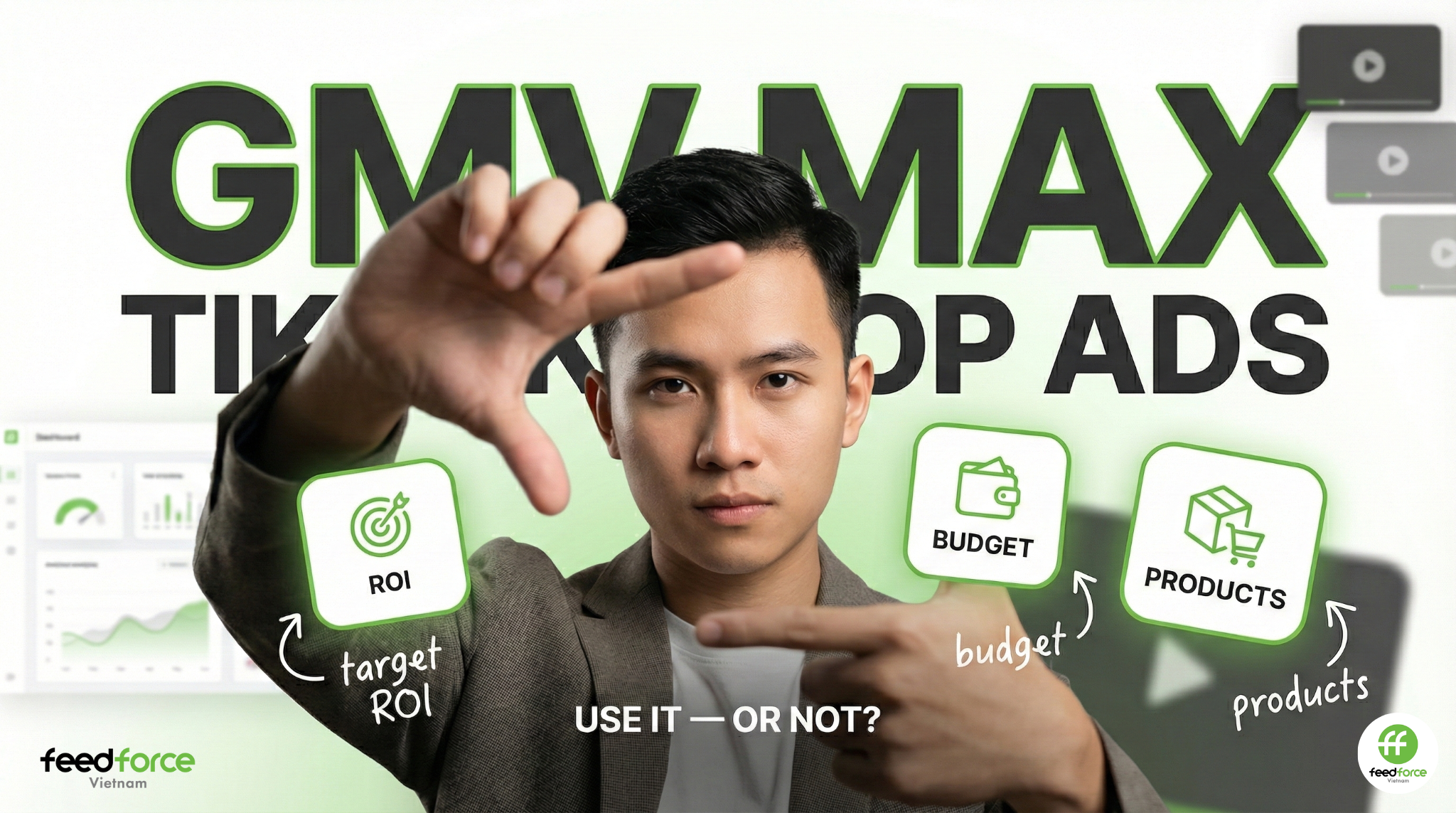
If you’re running TikTok Shop Ads, GMV Max is quickly becoming the default way to drive sales—so the real question isn’t “Should I use it?” but “How do I structure it so it learns fast and scales safely?”
In our GMV Max overview, we explain why GMV Max behaves more like an optimization engine than a traditional campaign type. This article focuses on the campaign structure that gives the engine clean inputs—so performance becomes predictable, not chaotic.
1. What GMV Max is—and why structure matters
GMV Max is built to optimize outcomes using the inputs you provide: products, target ROI, budget, and creative. It performs best when those inputs are clean and stable.
When people say “GMV Max doesn’t work,” it’s usually not because GMV Max is broken. It’s because the structure is broken:
Too many weak products in the promoted set
ROI target changes too often
Budgets too low for learning
Creative volume too thin
Operations (stock/shipping) can’t support scaling
Bottom line: GMV Max is not a switch you turn on. It’s a system you design.
2. Before you build: prerequisites checklist (15–30 minutes)
2.1 Governance (avoid preventable disruptions)
Confirm who owns the Shop, Business Center, and Ad Account access
Ensure one clear person/team can publish and edit campaigns
Freeze account changes during the first 7–14 days (roles/ownership/primary connections)
2.2 Shop readiness (ops fundamentals)
Stock stable for at least 14 days (especially hero SKUs)
Shipping fees/time won’t kill conversion
Variants are clean (no missing options, confusing naming)
Reviews/ratings are acceptable on promoted SKUs
Promo logic is consistent (vouchers/bundles apply as expected)
2.3 Measurement readiness (so you don’t optimize the wrong thing)
Define phase KPI: Learning → Scaling → Efficiency
Decide a change cadence (don’t edit everything daily)
Keep a “do-not-touch” list for week 1 (e.g., don’t change product set + ROI target together)
2.4 Creative readiness (GMV Max needs volume)
For each hero SKU: 3–5 creatives minimum (different hooks/angles)
A weekly refresh plan (new variations, not just re-uploads)
If you want a quick reminder of what GMV Max needs to work well, refer back to our GMV Max overview.
3. The recommended GMV Max campaign architecture (simple blueprint)
Instead of building “one campaign that does everything,” think in campaign roles. You may run 1–3 campaigns depending on scale:
Purpose: find new winners without destabilizing Core
Include: near-hero SKUs, new creative angles, test batches
Rule: test in batches (e.g., 5–10 SKUs at a time), not “dump the catalog”
3.3 Protection Campaign (profit safety)
Purpose: keep ROI stable when scaling gets volatile
Include: your safest margin SKUs (profit-stable even if CPA rises)
Use when: scaling periods, promo peaks, or ROI becomes unstable
Practical decision:
Small/medium catalog or limited creative capacity → start with Core only
Larger catalog and clear team bandwidth → add Expansion
If profitability is sensitive → add Protection
4. Product strategy (what to include—and exclude)
4.1 Start with a hero + long-tail mix
To avoid noisy learning, don’t start with everything.
Recommended launch mix (first 7–14 days):
70–80% Hero (proven conversion)
20–30% Long-tail (clean SKUs only)
Then expand long-tail gradually after stability.
4.2 Margin-first rule (don’t scale into losses)
Before adding a SKU, ask:
“If CPA rises 20–30%, do we still survive profit-wise?”
If not, don’t scale it in Core.
4.3 Exclusion list (do NOT put these in GMV Max yet)
Stockouts or unstable replenishment
High shipping cost/time vs competitors
Confusing variants or missing options
Weak ratings/reviews
Thin margin unless heavily discounted
No creative angles ready (no demo, no proof, no hook)
5. Target ROI setup (short, practical rules)
Target ROI is your guardrail. Most teams fail in two ways: set too high (no delivery) or change too often (unstable learning).
How to set it initially
Start realistic. If you set the target ROI aggressively from day 1, delivery can choke and learning slows.
How often to adjust
Avoid daily ROI changes. A safer cadence is every 3–7 days based on stability.
Three common traps
Target too high → restricted delivery
Target changes too often → unstable learning
Lowering ROI to force spend, then blaming the system for efficiency loss
6. Budget structure (don’t starve the engine)
There’s no “official minimum,” but artificially low budgets cause missed conversion opportunities and slow learning.
A practical operating goal
Try to reach ~15 conversions per week (using a short attribution window like 1-day if needed), so the system has enough recent signals to optimize.
Simple ramp plan
Week 1: budget sized to generate learning signals
Week 2: increase gradually if orders are stable
Week 3+: scale using rules (see Section 9) and add products/creatives before only adding spend
7. Creative pipeline (the real engine behind GMV Max)
If your creatives are weak or repetitive, GMV Max will plateau—even with great products.
Minimum baseline
Hero SKU: 3–5 creatives to start
Refresh: weekly (new hooks/angles, not just new edits)
5 angles that usually work well
Problem → solution → result
Demo with proof (before/after, test, usage)
UGC review (social proof style)
Comparison (“this vs that”)
Offer clarity (bundle, voucher, urgency)
8. 14-day launch checklist (compact)
9. Scaling rules (3 principles)
Scale horizontally first: add creatives + add clean SKUs before only increasing budget
Increase budget gradually: only when order volume and ROI trend are stable
Protect profitability: if scaling pushes delivery toward low-margin products, use a Protection structure
FAQ
1) How many SKUs do I need to structure GMV Max properly?
GMV Max performs best when it has enough variety to learn—typically several dozen products, not just 2–3.
2) Should I start with one campaign or multiple campaigns?
Start with one Core campaign unless you have enough SKUs, creative capacity, and operational stability to support Expansion/Protection.
3) How often should I change Target ROI?
Avoid daily changes. A safer cadence is every 3–7 days, based on stable signals.
4) Why is my GMV Max campaign spending but not getting orders?
Common causes: weak product pages, poor offer clarity, weak creatives, high shipping friction, or product set too broad/noisy.
5) What if my ROI drops after scaling?
Pause aggressive scaling, refresh creatives, tighten product set, and consider a Protection structure for margin-safe SKUs.
6) What matters most in the first 14 days?
Stable inputs: clean product set, enough budget for learning signals, and consistent creative refresh.
Conclusion
A strong GMV Max campaign is built on structure—not luck. If you design your architecture around Core stability, Expansion testing, and Profit protection, you’ll get cleaner learning, clearer decisions, and safer scaling.
If you want the “big picture” GMV Max context before sharing this with your team, link them to our GMV Max overview first—then use this guide as the operating blueprint.
GMV Max is TikTok Shop’s automated ad solution that optimizes for ROI, but success depends on product depth, creative velocity, and operational readiness. This article explains how GMV Max works in practice, when to use it, and the common pitfalls that limit scale.
Unlock your business's potential with social media! Explore the shift from traditional marketing to social platforms, and learn how Vietnam’s digital economy drives e-commerce. Discover the connection between brand building and performance marketing for lasting success.
UGC videos are short, authentic clips created by real users—not brands—that showcase genuine product experiences. This article explains what UGC videos are, why they build trust and drive engagement, and how brands can create effective, relatable content for social media success.



.png)
.png)
.png)
.png)
.png)
.png)