A quick disclaimer before anything else: this is my own pattern-matching from a lot of scrolling, not research. It may not be true, and it may not work for your category.
My story
I had five days off for Vietnam National Day. And I spent them doing literally … one thing: doomscrolling.
YouTube, autoplay, repeat. Climate news, politics, game reviews, business breakdowns, entrepreneur interviews. Somewhere after a few hundred videos I noticed something uncomfortable: I had stopped choosing what to watch. I was just reacting to titles.
So I started paying attention to the reaction instead of the content. Which titles made my thumb stop, and why.
Here is the clearest example I found.
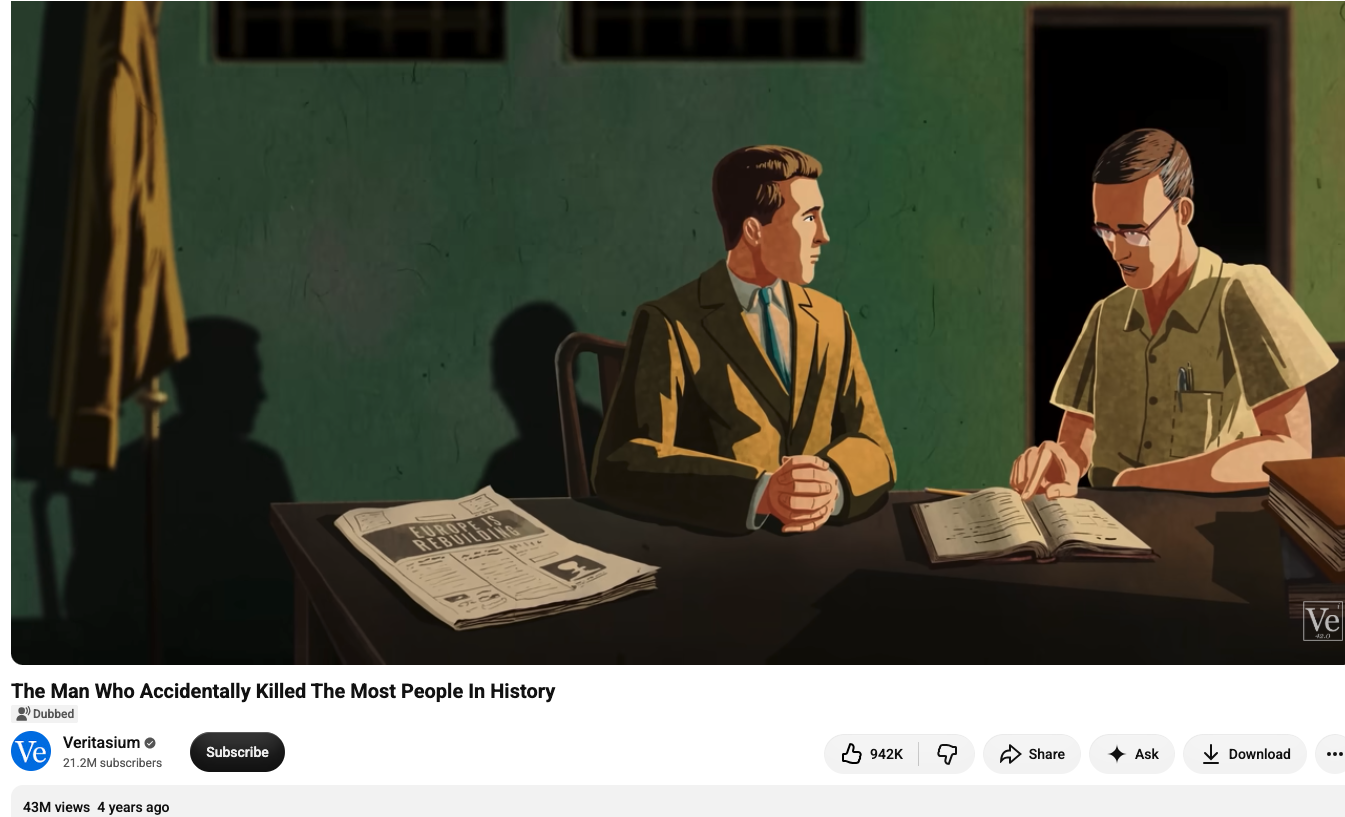
In April 2022, Veritasium published a video called "The Man Who Accidentally Killed The Most People In History." It has around 43 million views. The actual subject is leaded gasoline and CFCs, and the two chemists at the center of that story.
YouTube Video from Veritasium
Now write the honest, informational version of that title: "The History of Leaded Gasoline and CFCs." Same video. Same facts. Same quality. But it sounds much less interesting.
The difference is not the topic, but the angle of entry. One title names a subject. The other names a person, names a consequence, and then withholds the one detail you need to close the loop. You cannot resolve it without clicking.
That was the pattern I kept seeing. The titles came in from a side I did not expect.
Once you start paying attention, you can see the same move in many other YouTube channels, both Vietnam and foreign ones.
Rule of thumb: a title is a promise
This part matters more than the trick.
If the content does not deliver what the title promised, it is not a good headline. It is clickbait.
How many times only for the content to be nothing like what you expected? For me it brings back the images of tabloid journalism, when they always try to hit readers with sensational, shocking titles but lack the depth of content, and sometimes the headline was not even true.
That is an extreme example, but it is the same feeling your reader gets, just smaller, when an exciting title does not deliver.
Ragebait is the same trade at a worse rate. Anger is efficient. When people get angry they react, and the reaction usually includes telling you how angry you made them, which then makes more people angry. So before you reach for it, ask yourself why you want to put people in a bad mood. If that genuinely fits your brand for the long term, go ahead. I would say you almost certainly do not need it.
Here is the opinion I hold most strongly in this whole piece: In a market where anyone can generate a thousand title variations in under a minute with AI, attention has become cheap, and trust has not. Trust is the only asset that does not scale automatically, which makes it the only one worth protecting.
How to choose a title
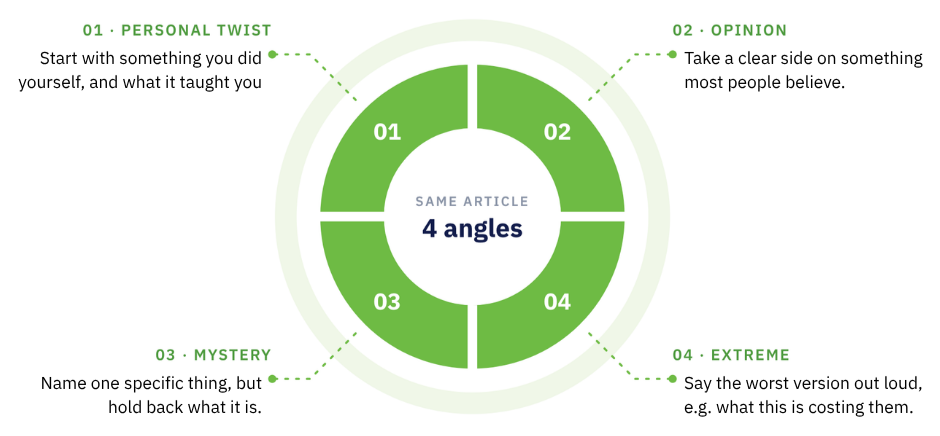
It comes down to one thing. Give the title an angle nobody else can give it.
The personal twist: Ask yourself what you saw in this piece that nobody else saw, then put that in the title. This is my favorite, because it is the only one that cannot be copied.
The opinion: Pick a side. Half your readers click to agree with you, the other half click to prove you wrong. Both count. RealLifeLore's "Why Japan's Geography Sucks" is this angle, at around 5 million views.
The mystery. Leave one thing out. People hate an open loop. Wendover Productions does it with "The Insane Logistics of Shutting Down the Cruise Industry." What logistics? You have to open it to find out.
The extreme. Make a big claim. This is the YouTube effect and it does work. It is also the one I would be most careful with, for the reason below.
Now try it on something boring
Pick a topic you know well and find dull. Mine is product descriptions.
The plain title:
How to Write Better Product Descriptions
True, accurate, invisible.
Now run it through the four angles. This took me about two minutes (or ten, I’m not sure):
Personal twist: I Rewrote 200 Product Descriptions. Only One Change Mattered.
Opinion: Most Product Descriptions Are Written for the Wrong Person
Mystery: The Only Line Buyers Actually Read on Your Product Page
Extreme: Your Product Description Is Losing You Every Sale
Four headline angles
Which would I publish? Probably the opinion one. Not because it is the catchiest, but because it is the one I can defend. I think Number 4 sounds the best, but I cannot prove it, so it would cost me more than it earns.
That’s the whole test. Pick the most interesting title you can still pay for.
How to get better at this
It is simple to practice, and you do not need a professional course for it.
Read headlines on purpose: There are billions of them out there. Spend twenty minutes in your own niche: blogs, Substack, Medium, news sites, YouTube, Facebook. Remember that you are not reading the articles, you are studying the titles.
Name the angle: Every time one catches you, ask why. Is it an opinion? A little extreme? Holding something back? Or something you have not seen before, which is the most useful find of all.
Then look at your own: Open your last five titles and ask which angle each one used. Very often the honest answer is none. That is fine. Now you know what to adjust.
Use AI for volume, not for judgment: Ask Claude, ChatGPT or whatever you use for ten variations of a title. It is genuinely good at volume. It has no idea which promise your content can actually keep, so that part stays with you.
Read the piece against the title one last time: Every single time, before publishing. This is the step everyone skips, and it is the only one that protects your reputation.
None of this is new advice
You may have heard about the importance of titles and tips on how to write one thousands of times. But for me, the content you deliver is always the most important part.
Treat a “good title” as a plus for you to grab people’s attention to your valuable idea. Get the title right and it does most of the work of getting someone to start reading. And the more of the right people you get reading, the more chances you have that some of them care about what you actually do.
However, sometimes the boring title is the correct answer
The other trap is assuming every title needs a twist.
If someone types "shopee ads not spending budget" into Google, they are obviously in pain and they want a match. A mysterious title on that page is not creative, it is friction.
The useful split is not "clever versus boring." It is where the title has to compete.
In a feed: Your title competes with everything else a person could look at. Nothing is filtering for intent, so the angle is what earns the stop.
In search and AI answers: Your title competes with nine near-identical results, and the reader has already declared what they want. Clarity is the angle.
The rule I ended up with
After all that wasted holiday time, my takeaway is one short sentence:
Write the title you would actually click. Then check that you can pay for it.
The product detail page is where buying decisions are made or lost. Many brands overlook its importance, leading to missed conversions. Learn how to fix common PDP mistakes, build trust, and create seamless, mobile-friendly experiences that drive sales.
This article explores how marketers can use AI to move beyond repetitive execution and focus on higher-value work. From research and content creation to SEO, prompting, and quality control, it outlines how AI can become a practical performance advantage in modern digital marketing.
For foreign brands in Vietnam, combining Organic Search with Paid Ads isn't optional - it's the smartest move. Paid Ads bring speed; SEO builds trust. Together, they lower CPA and ensure your brand stays visible long after the campaign budget runs out.